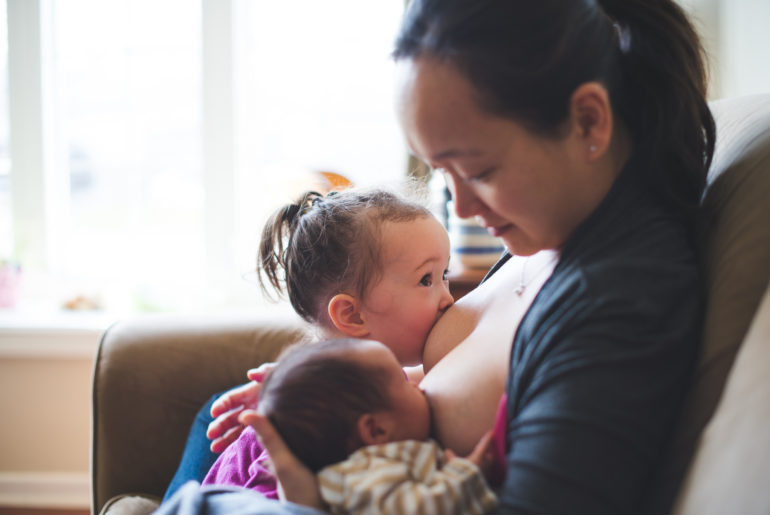
Caring for the carers
28.10.24
This International Day of Care and Support, we are calling for change.
Despite their decisive role in caring for their children and for the future of our societies, mothers are yet to be fully supported or recognised as positive contributors to societal and developmental challenges.
Worldwide, women who are mothers are poorer than others. They face more penalties in their professional lives, their mental and physical health and their ability to participate in public life.
The Motherhood Penalty, parental burn out…these are very real issues that are increasingly being recognised but not addressed. Why?
Look at the statistics:
- 76.2 per cent of the total amount of unpaid care work, 16 billion hours per day globally, is performed by women, mostly mothers. That’s 3.2 times more than men
- 7.7 million women across the EU are kept out of the labour market due to care responsibilities, compared to 450,000 men. In 2018, 606 million women were unavailable for employment due to unpaid care work compared to only 41 million men. This has a huge impact on their ability to access social protection and an adequate pension in old age
- 649 million women (34 per cent of women of child bearing age) still lack adequate maternity protection worldwide, including income security during maternity leave
The urgent issues facing mothers around the world are numerous and they all have an impact on the future generation: food insecurity, poverty, climate change, physical and mental health, armed conflicts, work-life imbalances.
It is our mission to fight on their behalf, to defend their rights and their ability to make decisions for themselves and their families, and to enable them to take action.
For all that they do, it is time to care for the carers of the future.
Because when empowered and informed, mothers have the power to re-shape our world.
 Share
Share Share
Share Print
Print Email
Email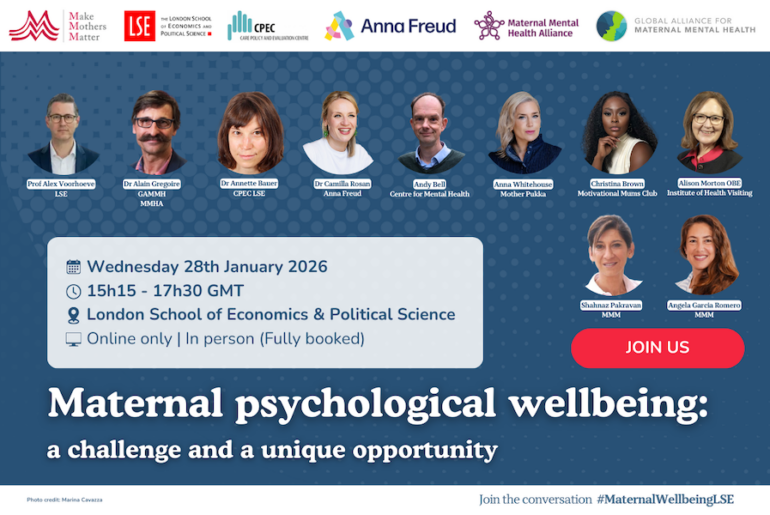
Maternal Psychological Wellbeing: A Challenge and a Unique Opportunity
13.01.26
Wednesday 28 January 2026 | 15:15 – 17:30 GMT London School of Economics & Political Science (LSE) – Live broadcast #MaternalWellbeingLSE Maternal mental health is one of the most pressing

Climate Change: A Maternal Physical and Mental Health Emergency
13.11.25
In the lead-up to the UN climate change conference in Belem, Brazil (COP30), MMM was delighted to collaborate with Dr. Saravanan Thangarajan, a Visiting Scientist & Faculty member at Harvard
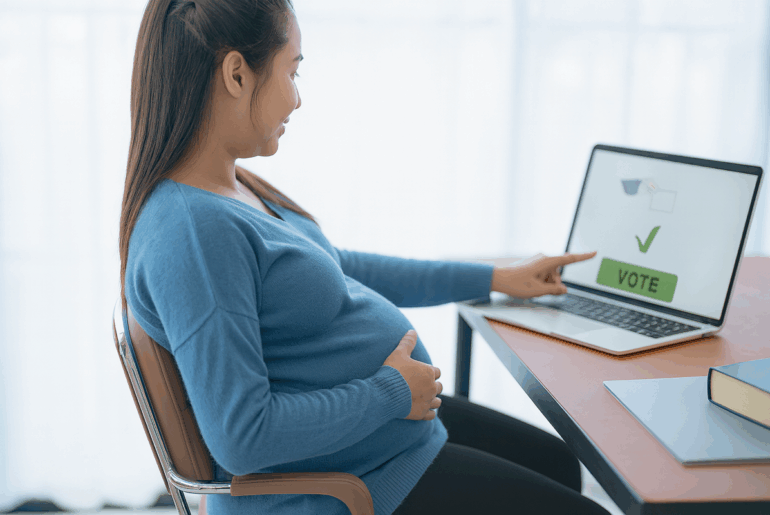
Democracy on Hold: The Hidden Penalty for Parliamentarians Who Become Mothers
27.11.25
The European Parliament adopted a legislative resolution on the amendment of the European Electoral act, allowing Members to vote in plenary by proxy voting during pregnancy and after giving birth.