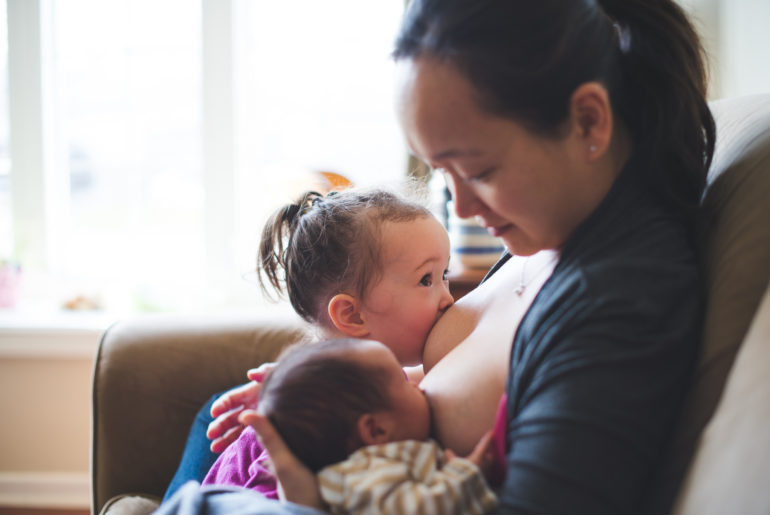
Unpaid Care at the Core: A Catalyst for Achieving the SDGs
06.07.25
UN New York / HLPF - Register now to join us online for our High Level Political Forum side-event.
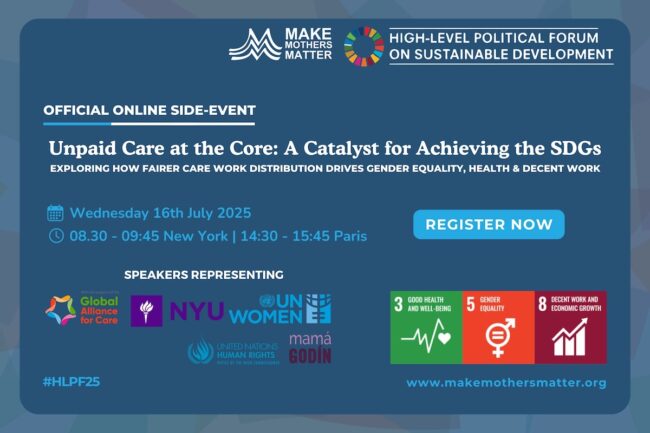
📆 Wednesday July 16 – 8:30-9:45 am New York / 2:30-3:45 pm Paris
📍 Online – REGISTER HERE
The unequal distribution of unpaid care work lies at the heart of gender inequality and remains a major driver of economic and social injustice for women, in particular when they are mothers. This issue is recognised under Target 5.4 of the 2030 Agenda for Sustainable Development.
Addressing unpaid care work is essential not just for achieving gender equality (SDG 5), but also because it is deeply interconnected with many other Sustainable Development Goals (SDGs)—particularly SDG 3, Ensure healthy lives and promote well-being for all at all ages, and SDG 8, Promote inclusive and sustainable economic growth, full and productive employment, and decent work for all, both of which are under review this year.
Our online side event will explore these critical interlinkages and demonstrate how addressing the inequitable distribution of unpaid care work and placing care at the centre of policymaking can create powerful synergies across sectors and goals. By drawing on diverse experiences and evidence, we will highlight the transformative potential of care-focused policies in advancing a more just, equitable, and sustainable world.
Programme & Speakers
Welcome & introduction
- Farah Arabe, Representative to the UN in New York, Make Mothers Matter
Moderator
- Raquel Coello Cremades, Policy advisor macroeconomics and Global lead on Care, UN Women
Panellists:
- Donna Cill, Associate Professor and Deputy Director, NYU Rory Meyers College of Nursing
- Hannah Wu, Chief, Women’s Rights and Gender Section, OHCHR
- Nikki van der Gaag, Consultant & Writer; Senior fellow at Equimundo
- Aideé Zamorano, Founder and President, Mama Godin, Mexico
- Camila Gómez Guzmán, Director, District Care System, City of Bogota, Colombia
Concluding remarks
- Ana Moreno, Technical Secretary, Global Alliance for Care
Note: Spanish and French interpretation will be provided.
Objectives of the Side-Event
The main purpose of this side-event, which will take the form of a panel, is to shed light on the inter-linkages between unpaid care work and SDGs beyond SDG5, including SDG3 and SDG8, which are all under review.
Our objectives are to:
- Highlight the centrality of care to the realisation of many SDGs beyond SDG 5, in particular SDG 3 and SDG 8
- Show how addressing the issue of the inequitable distribution of unpaid care and domestic work in a cross-sectoral manner can foster synergies, thereby contributing to the implementation of SDG 3 (including early childhood development, mental health) and SDG 8 (including women’s labour force participation, a just transition)
- Provide concrete examples of policies and practices that have successfully created such synergies
- Call on governments at every level to implement cross-sectoral care systems that recognise, support and redistribute the unpaid work of caring
Join us as we centre care in the conversation – because building a just, healthy, and sustainable future for all begins with valuing and redistributing the unpaid care work that underpins our societies.
→ Register NOW
Resources:
On engaging men in Care
- Equimundo’s State of the World’s Fathers series
- Equimundo’s Program P
- The Boyhood initiative
- Men Care Alliance
On Bogota’s Care district system
 Share
Share Share
Share Print
Print Email
Email
Maternal Psychological Wellbeing: A Challenge and a Unique Opportunity
13.01.26
Wednesday 28 January 2026 | 15:15 – 17:30 GMT London School of Economics & Political Science (LSE) – Live broadcast #MaternalWellbeingLSE Maternal mental health is one of the most pressing

Climate Change: A Maternal Physical and Mental Health Emergency
13.11.25
In the lead-up to the UN climate change conference in Belem, Brazil (COP30), MMM was delighted to collaborate with Dr. Saravanan Thangarajan, a Visiting Scientist & Faculty member at Harvard
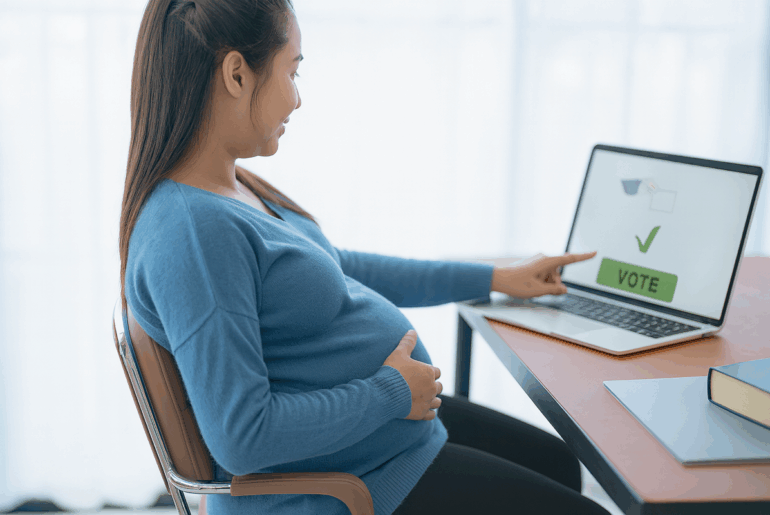
Democracy on Hold: The Hidden Penalty for Parliamentarians Who Become Mothers
27.11.25
The European Parliament adopted a legislative resolution on the amendment of the European Electoral act, allowing Members to vote in plenary by proxy voting during pregnancy and after giving birth.