Motherhood and the Beijing Agenda – a retrospective
10.05.25
UN New York – The 69th UN Commission on the Status of Women (CSW69) marked the thirtieth anniversary of the Beijing Declaration and Platform for Action (BPfA). This landmark global policy document was adopted by 189 countries at the Fourth World Conference on Women held in Beijing, China in 1995. The Platform for Action, which is considered one of the most comprehensive and progressive blueprints for gender equality worldwide, explicitly calls for the recognition and support of mothers. In its parallel event, Make Mothers Matter took this opportunity to discuss solutions to address the multiple hurdles and challenges faced by mothers globally.
Motherhood in the Beijing Platform for Action – The missing link to sustainable development
Our representative at the United Nations, Farah Arabe, moderated this panel and opened the session by framing motherhood as a powerful, yet neglected engine of sustainable global development.
- Drawing from scientific research, she asserted that mothering shapes early childhood attachment, which has a life-long influence on our brains and biological systems. Nurturing, early relationships are conducive to higher academic achievement and economic productivity; they set the foundation for long-term physical and mental health; and serve as a model for all future relationships. Mothers are key actors of early childhood development
- At the aggregate societal level, this translates into wealthier, healthier, more equitable, cohesive and peaceful societies
Despite specific commitments to the health, education and employment of mothers, the Beijing Declaration and Platform for Action does not acknowledge positive early relationships nor their long-term impact on society.
Farah concluded by asking the panelists to assess, within their respective areas of expertise, the progress made on mother-specific commitments in the BPfA.
A Social Affair: the BPfA on Health and Education of Mothers
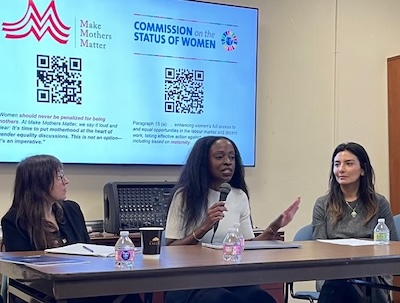 Donna Cill, Associate Professor and Deputy Director, World Health Organisation Collaborating Center at NYU College of Nursing, talked about the importance of maternal health and education, highlighting the need for greater awareness, advocacy and action on four specific areas:
- Breastfeeding: It is a human right for infants and mothers. It is also crucial for child immunity, IQ, and maternal health, and generates $35 return per $1 invested. It is necessary to advocate for moms to breastfeed and make sure that communities and hospitals have lactation consultants, skilled health workers and appropriate facilities to enable breastfeeding
- Fourth Trimester: This is the term used to describe the three months after the mom has a baby. Society does not pay sufficient attention to the mother’s postpartum care; mental health and cardiovascular risks, which are high in the first 3 months post-birth. We need to make sure that these women are getting the support they need
- Health Literacy: Educated mothers improve family health and reduce non-communicable diseases, like hypertension and diabetes
- Mother-child Communication: When mothers speak to their child, it can reduce every health risk behaviour. it’s a protective factor throughout their lives. The voices of women are powerful
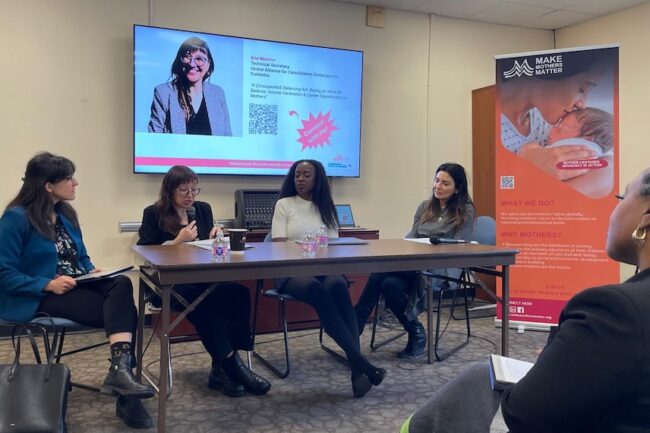
A (Unsupported) Balancing Act: The BPfA on Work-life Balance, Income Generation and Career Opportunities for Mothers
Ana Moreno, Technical Secretary of the Global Alliance for Care, centred her presentation about Beijing on work-life balance, income generation, and career opportunities for mothers. On the positive side, the Platform for Action recognises the urgency of providing childcare services and the necessity of promoting equal sharing of parenting responsibilities by men and women in families. It also acknowledges the challenges imposed on mothers, especially young and single mothers, due to their care responsibilities.
However, today:
- Globally women perform 76.2% of unpaid care work, which impacts their wellbeing and personal development: women who are mothers often see themselves with no time for themselves. Their disproportionate share of care responsibility and work also affects their ability to fully participate in the Labour force and generate an income.
- There is a lack of support, networks, accessible and quality childcare services and supportive policies in the labor sector.
In response, the Alliance focuses on understanding care as a right, a need, valuable work, and a public good. It is an investment in people and society. Ana advocated to change the narrative about how we care, who cares for us, and how we go about caring in the future. She discussed the need for a systematic view and advancements at different levels and sectors, international and local, health and educational, keeping care at the center. She closed by highlighting two innovative models of care:
- Bogotá Care Blocks (Colombia) and Utopias (Mexico City): Public infrastructure providing holistic care support.
- Germany & Barcelona: Programs promoting parental leave and free childcare for low-income families.
Best Practices from the Children’s Perspective: The Importance of a Two-Generational Approach and the Consequences of Maternal Absence
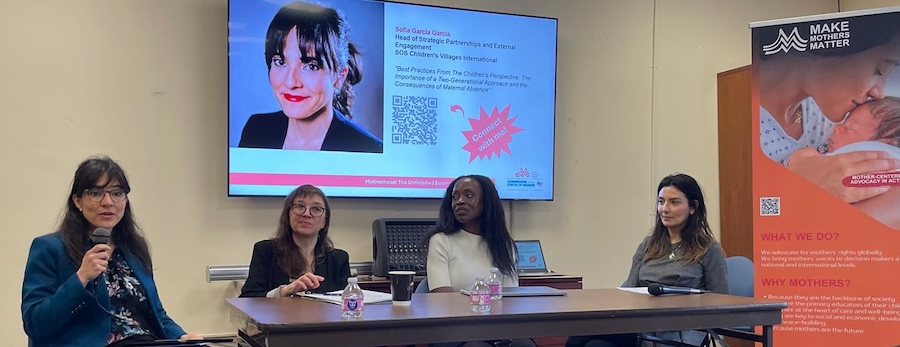
Sofia Garcia Garcia from SOS Children’s Villages International joined the conversation talking about best practices from the perspective of children, the importance of a two-generational approach to solutions and the consequences of maternal absence.
- She emphasised attachment as essential to brain development, emotional resilience, and long-term relational health. Lack of maternal care results in intergenerational trauma and systemic costs.
- She warned against institutional neglect, advocating for early, responsive caregiving from all societal levels.
- She therefore advocated for a paradigm shift: care as a right, not a personal burden.
Open Discussion
In conclusion, participants interacted and brought important topics to the conversation, highlighting intergenerational and systemic solutions, the recognition and valuation of unpaid care work and collaborative action and advocacy.
Participants:
- Stressed the need for integrated care policies benefiting both children and aging populations
- Called for recognition of grandparents as vital but unsupported caregivers
- Called for intersectional solutions addressing gender, age, and socio-economic status
- Emphasised that Unpaid care is foundational yet invisible in most economic models
- Multiple speakers called for redefining GDP metrics to include care and for stronger social protection for mothers and caregivers
- Advocated for maternal health and political reform
- Urged for the extension of maternal support beyond pregnancy and childbirth to postpartum and child-rearing
- Recognised the value of doulas, educators, and community workers
Conclusion: Final reflections from Speakers
Sofia: Care is the most powerful tool for societal transformation—emotionally, economically, and politically
Ana: Let’s put care at the center of all policies and recognise everyone as both caregivers and care-receivers
Donna: Reimagine motherhood with systemic support; every supportive act can be transformative
 Share
Share Share
Share Print
Print Email
Email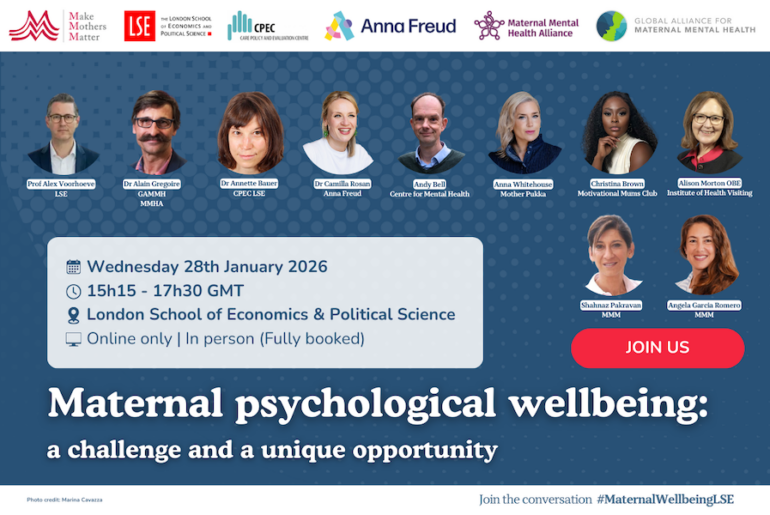
Maternal Psychological Wellbeing: A Challenge and a Unique Opportunity
13.01.26
Wednesday 28 January 2026 | 15:15 – 17:30 GMT London School of Economics & Political Science (LSE) – Live broadcast #MaternalWellbeingLSE Maternal mental health is one of the most pressing

Climate Change: A Maternal Physical and Mental Health Emergency
13.11.25
In the lead-up to the UN climate change conference in Belem, Brazil (COP30), MMM was delighted to collaborate with Dr. Saravanan Thangarajan, a Visiting Scientist & Faculty member at Harvard
Democracy on Hold: The Hidden Penalty for Parliamentarians Who Become Mothers
27.11.25
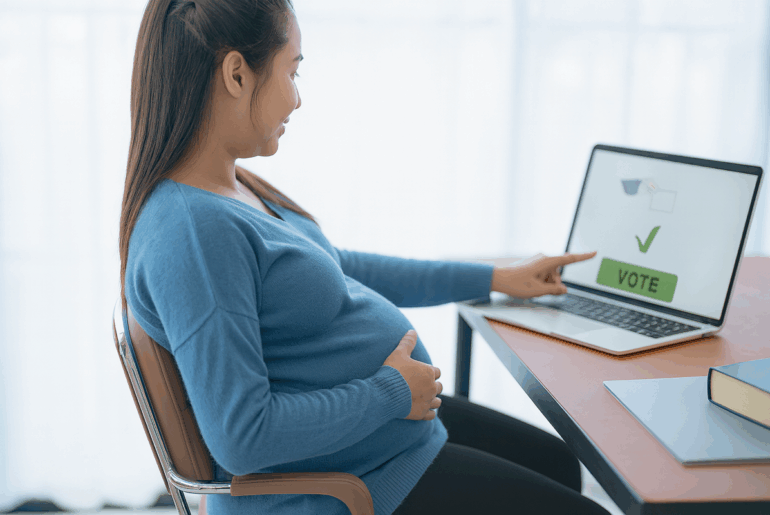
The European Parliament adopted a legislative resolution on the amendment of the European Electoral act, allowing Members to vote in plenary by proxy voting during pregnancy and after giving birth.