MMM reaffirms: caring for a child is work, an absolute necessity, resource and investment
29.03.21
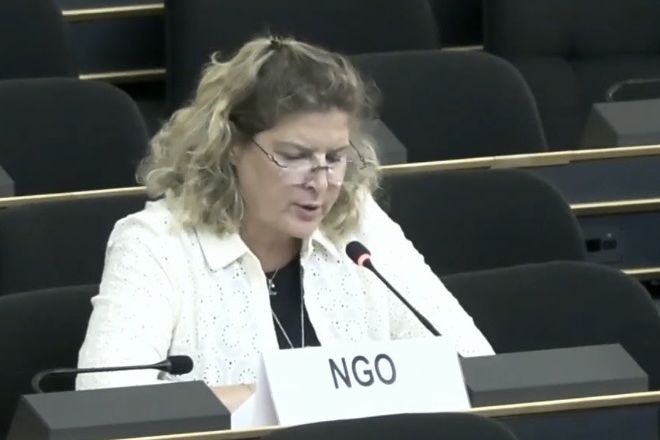
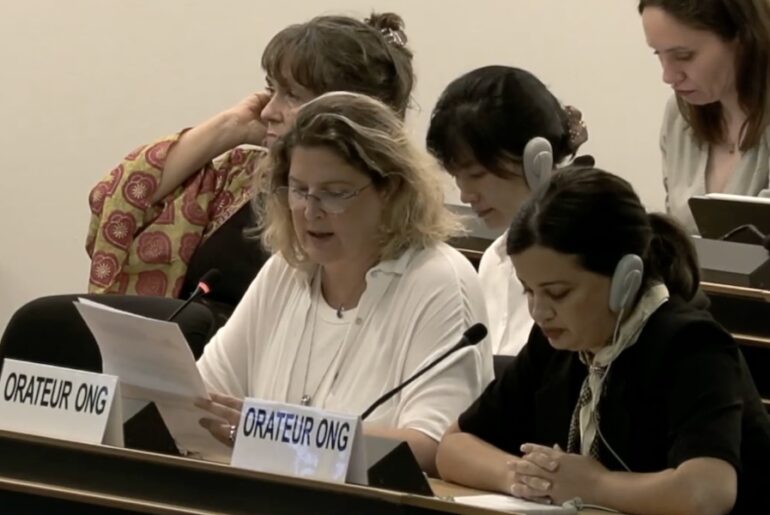
UN New York, CSW65 - In her intervention at a parallel event to the 65th UN Commission on the Status of Women organized by OMEP, MMM President Anne-Claire de Liedekerke also drew attention to the price mothers pay for the care they give to their children. She said 'it has to stop'.
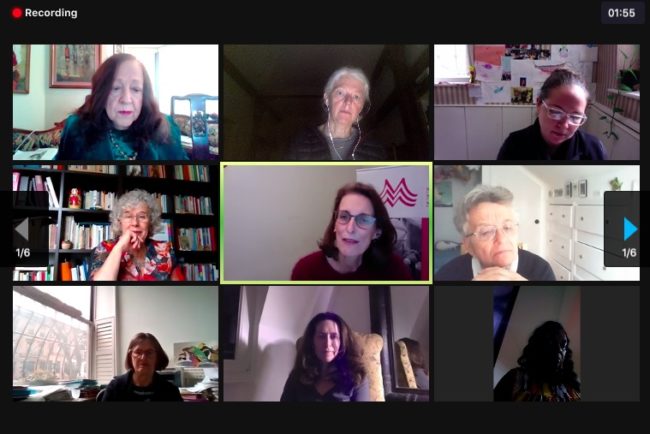
The following is the full text of her presentation.
Why are we linking care and mothers’ rights?
Because care is indeed performed by women but a lot of them are engaged in care activities for their children (and these women are called “mothers”)
- In some countries they are fetching wood and water for their family
- Everywhere in the world they are cooking, cleaning, carpooling, managing children’s needs
- In doing that they are caring for their children who also need their mother’s nurturing and loving care
All of that takes time, energy and is an absolute necessity for the children, but also for the economy, for society at large, for development, for peace as Rima reminded us and for our future.
The type of care I will address today is the nurturing care that children need and that is given to them by their mothers.
Fathers matter just as much as mothers, and we all know how important it is that they take their fair share of caring for their children. But today I will address the case of mothers because, worldwide it is a vast majority of mothers who care for their children, that is a fact, and because I represent Make Mothers Matter.
Care is linked to children’s rights
 Care is an absolute necessity for the child. Its very survival depends on it. But above and beyond that its emotional development, which conditions its behaviour as an adult, depends on the quality of that care. Embedded in our memories are the stories of those Romanian orphanages where babies had suffered lack of nurturing care and as a result had smaller brains.
Care really matters for the development of a child and for its behaviour as an adult. Care is fundamental.
Still too often the word “care” is associated with the word “burden” with “kitchen & diapers”, “waste of time and competences, low rank activity “motherhood and apple pie” as if it was an unimportant task. This is sad because there is so much more in care.
Care is a Treasure: caring for each other is not only necessary it is also the one thing that makes us happy.
Care is a Resource: indispensable to support the world’s economies.
Care is an Investment. As I said, care is crucial for a child’s development: it is an investment in the child’s future and therefore in our societies’ future.
Care is work
You might have seen that video of real interviews with real applicants for a fake job. Here is how the job was described: “The most important job”, “Director of operations”, “Responsibilities are quite extensive”, “24H/7 days and 365 days a year”, “No vacation and workload goes up during holidays”, “sometimes you will have to stay up throughout the night”.
The interviewees are simply puzzled, saying that such a job is inhumane, or illegal… Then they hear that the position carries no pay! They collectively scream and the interviewer then breaks it to them that ‘actually billions of people hold this position right now’… MOTHERS!
Care IS work: of course care requires love and sacrifice, but also requires time and energy, commitment and genuine attention, organisation and dependability.
If it is not performed within the family for free, it will be externalised at a cost to the community and will then enter the GDP. But when the mother does it, because there is no pay, it remains unrecognised notwithstanding its economic value and its importance as a support to all our economies.
Unpaid family care work might be very hard, even more so in developing countries, because of the lack of services and infrastructures, particularly for single mothers. But it still is the most important job there is to do, the most important “work”. And someone has to do it.
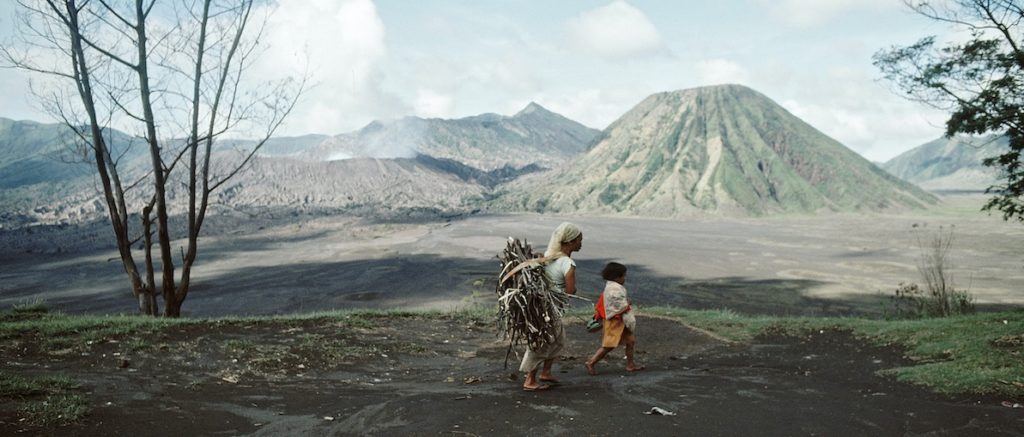
@ UN Photo Pernaca Sudhakaran (Java)
We have to acknowledge that it is mostly mothers who do it.
Mothers, who fetch wood and water for their families.
Mothers, who take leave to care for their children (and this was exacerbated during covid).
Mothers who take part time jobs or temporarily leave the labour market for childcare purposes.
Mothers pay the price for the care they give to their children
The impact on mothers depends on their environment and personal circumstances but everywhere mothers have to pay the price for the care they give to their children. It has names: “motherhood penalty”, “gender pay gap”, “pension gap”, “poverty”, “disempowerment”, “dependence”, “lack of income generating activity”, “lack of bargaining power within their household”.
Why is that? Because when they care for their children they earn no money so it has no value. They do nothing worthy of recognition.
This has to stop.
What kind of world do we live in? When the treasure of care is counted for nothing unless it is externalised and then enters the GDP.
The injustice of all this on mothers cannot be tackled if unpaid family care work is not visible.
As Antonio Guterress recently said: COVID-19 has been like an x-ray, revealing fractures in the fragile skeleton of the societies we have built. It is exposing fallacies and falsehoods everywhere: … among others: the fiction that unpaid care work is not work.
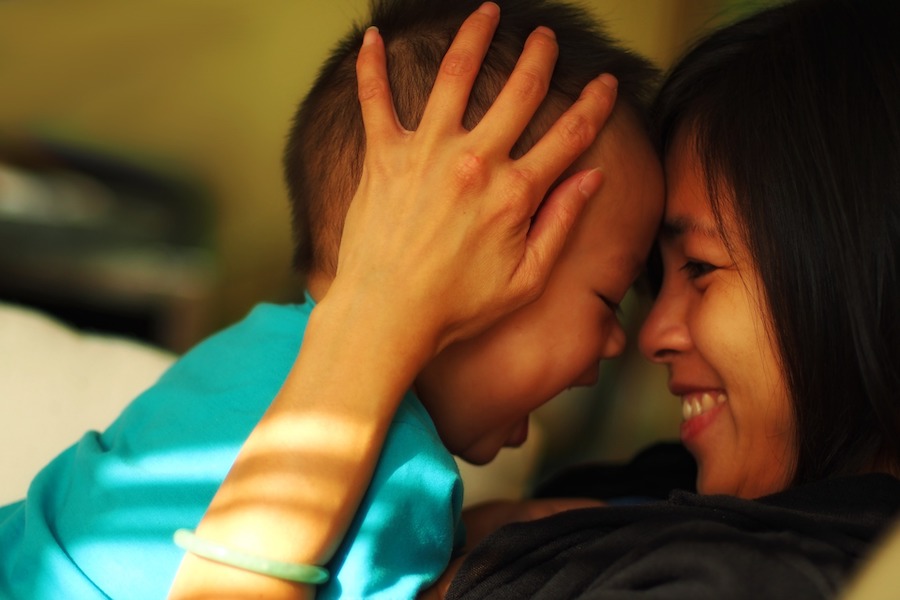
There are movements toward the recognition of unpaid care work
- Recognition of unpaid care work is a specific target of the Sustainable Development Goals (SDGs) adopted by all United Nations Member States in 2015, a call for action by all countries – developed and developing – in a global partnership.
SDG 5 – Target 4 aims to “Recognize and value unpaid care and domestic work through the provision of public services, infrastructure and social protection policies, and the promotion of shared responsibility within the household and the family as nationally appropriate” - Feminist economists have been very active for many years in tackling the inequitable distribution of unpaid care work as a root cause of Gender inequalities and discriminations. MMM is resolutely feminist in that we believe that gender equality will never be achieved if it doesn’t take into account the specificity of maternity and motherhood
- One step towards the recognition of unpaid care work as ‘work’ has been taken by a 2013 resolution of the ICLS (International Conference of Labour Statisticians): they are now including as “work” the production of goods and services produced at home for personal use or for the use of other household members
- In the very recent EU Directive to introduce pay transparency measures, it is encouraging to note that in the explanatory memorandum of the proposal, the European Commission considers unpaid care work as a root cause of the gender pay gap
- January 2021 EIGE (European Institute for Gender Equality) issued a publication entitled Gender inequalities in care and consequences on the labour market highlighting that women’s disproportionate share of care work is one of the main root causes of the gender pay gap
All these are steps in the right direction in the recognition of unpaid care work.
And of course, the publication of the Nurturing Care Framework was a milestone. Entirely dedicated to the importance of early childhood development their motto is so convincing: “If we change the beginning of the story, we change the whole story”.
That says it all.
If care can change the story it matters not only to children but also to all of us.
It really is time to change our personal mindset about care, particularly mothers’ care for their children, because it is crucial to the next generation.
Today the future of our children is in our hands but tomorrow it is our future that is going to be in their hands.
So the recognition of unpaid family care work is not just a mother child win-win, it is also a global and multi generational win-win.

MMM President’s presentation for download
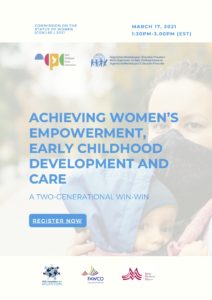
Anne-Claire de Liedekerke, President of Make Mothers Matter, contributed this presentation to the parallel event organised by OMEP (Organisation Mondiale pour l’Education Préscolaire) and our partner ECPC (Early Childhood Peace Consortium) on the margin of the 65th session of the UN Commission on the Status of Women on ‘Achieving Women’s Empowerment, Early Childhood Development and Care; A Two-Generational Win-Win’.
See also the Event Recording & the Event Program
 Share
Share Share
Share Print
Print Email
Email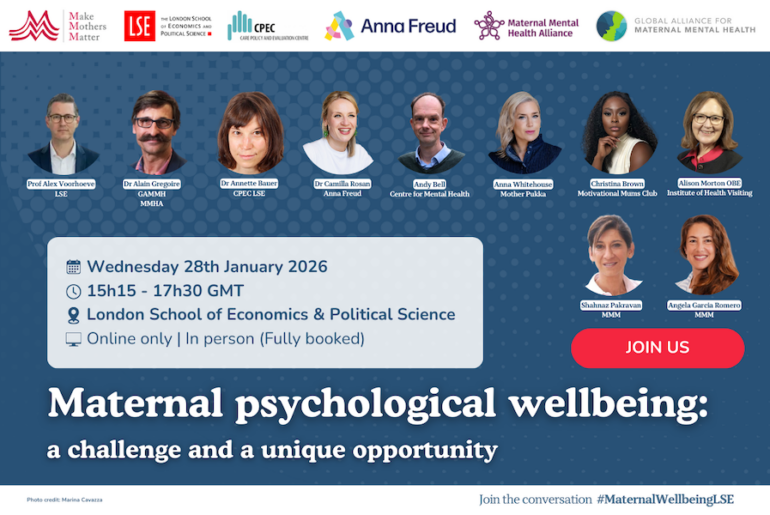
Maternal Psychological Wellbeing: A Challenge and a Unique Opportunity
13.01.26
Wednesday 28 January 2026 | 15:15 – 17:30 GMT London School of Economics & Political Science (LSE) – Live broadcast #MaternalWellbeingLSE Maternal mental health is one of the most pressing

Climate Change: A Maternal Physical and Mental Health Emergency
13.11.25
In the lead-up to the UN climate change conference in Belem, Brazil (COP30), MMM was delighted to collaborate with Dr. Saravanan Thangarajan, a Visiting Scientist & Faculty member at Harvard
Democracy on Hold: The Hidden Penalty for Parliamentarians Who Become Mothers
27.11.25
The European Parliament adopted a legislative resolution on the amendment of the European Electoral act, allowing Members to vote in plenary by proxy voting during pregnancy and after giving birth.