What matters to mothers in Europe

 The 2011 survey that was carried out by MMM’s European Delegation among almost 12,000 mothers in Europe, in 16 countries and in 10 languages, continues to provide guidance for the work of the delegation.
Almost all mothers say that being a mother is a source of enormous satisfaction. However, MMM’s survey reveals a strongly-held and general concern about the lack of choice, time, recognition, particularly for mothers in precarious situations, mothers raising children on their own or mothers in difficult situations regarding family.
The mothers of Europe want:
Time for their families
The mothers essentially want measures to have a direct impact on their daily lives as well as to aim at improving the balance between work and family life.
Choices regarding childcare
The mothers want recognition for the important role of stay-at-home mothers and fathers (either full or part-time) who have made the choice to take care of their children themselves. They want an option that is financially feasible for outside childcare and care by the mother or father, allowing them to take care of their children up to school age.
Recognition of their role of mothers
The mothers want better recognition by society of the importance of childcare and motherhood. They ask that families be considered a basis of social unity and a resource for society as a whole. By educating and caring for their children, mothers and fathers are working towards the future of our society.
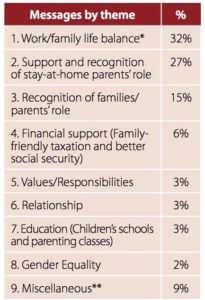
Whatever their origin, age and socio-demographic profiles, over 11,000 mothers across Europe expressed similar opinions, desires and concerns. The mothers who replied to our survey have strong feelings of responsibility towards their families and their children. They also recognise that being a mother is vital for themselves, their children, their families and society.
For the majority of European families, time management is difficult because of the tension between work and family life, particularly during the busy times in their lives when flexibility is essential. Employers, politicians and the public should be aware of the difficulty mothers face during their careers, when attempting to balance work and caring and educating their children.
Within the framework of our European democracies, MMM’s mission is to help society evolve and become more aware about the realities mothers face as caregivers. We hope that politicians will hear the voices of these mothers, their constituents, and along with other stakeholders, will find new ways to support mothers and their families, knowing that the children of today are the European citizens of tomorrow.