Mothers run the most demanding start-up: the family
24.03.24
UN New York, CSW68 - These wise words, uttered by of one of the speakers at our event, Let's change the narrative: invest in mothers, sums up the challenges faced by mothers. Organised online on the margins of the 68th UN Commission on the Status of Women, our panel discussion brought together professionals from civil society, academia and the private sector, to discuss why investing in mothers - who account for over two billion women worldwide - makes sense and how to go about achieving this.
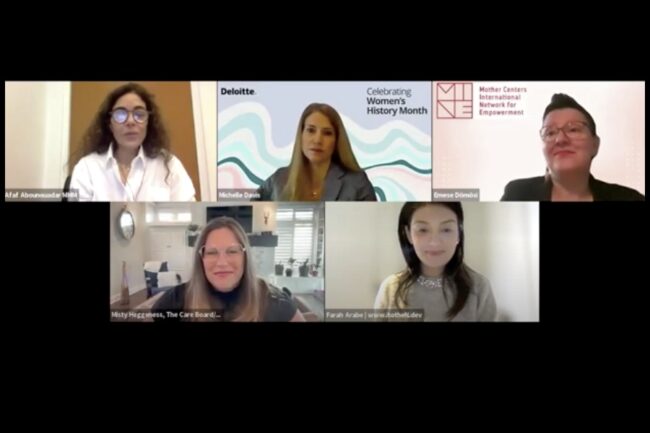
We thank our speakers for their insightful – and at times passionate – contributions to the discussion:
- Emese Domosi, Board Director, Mothers centers International Network for Empowerment (MINE), an MMM member association – Read her speech
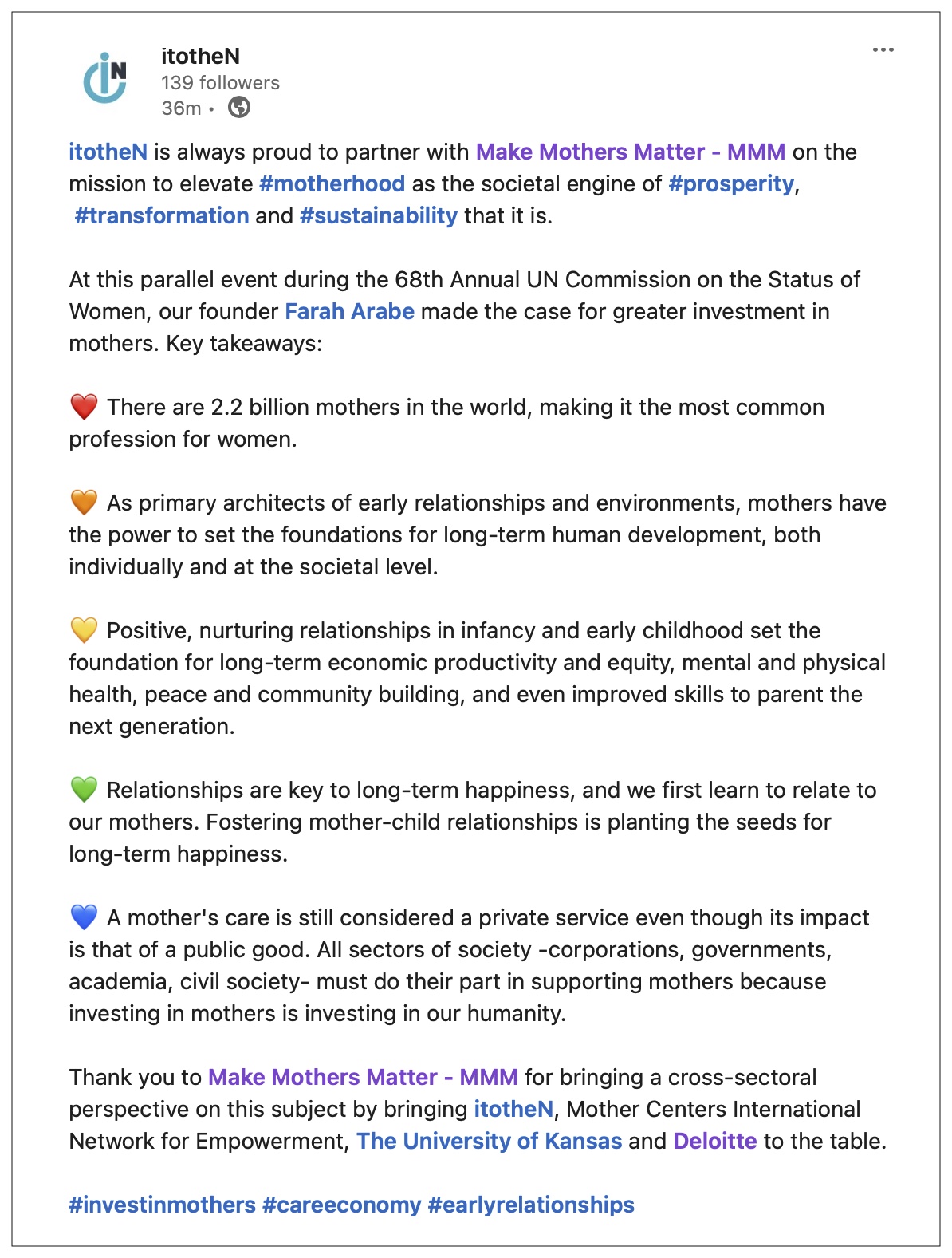
- Farah Arabe, Founder & President, itotheN Consulting & Co-President, Harvard Kennedy School Women’s Network – Read her speech and additional thoughts
- Misty Heggeness, Associate Professor, School of Public Affairs and Administration, University of Kansas
- Michelle Davis, Tax Principal, Deloitte
- Afaf Abounouadar, Executive Director, Make Mothers Matter (moderator)
We also thank the MMM volunteers and friends who interviewed people for the Vox Pop video, Investing in mothers – Voices from the streets of Brussels, New York and Paris, which opened the discussion.
Our panel was agreed on one critical point: empowered and supported mothers wield significant influence as catalysts for societal progress, actively contributing to the collective endeavour of shaping a more promising future. Across various spheres, multifaceted initiatives are being implemented to foster their recognition, empowerment and engagement.
One such initiative, the Mother Centers International Network for Empowerment (MINE), unites over 1000 Mother Centers worldwide, spanning more than 20 countries. MINE’s main mission is to facilitate the empowerment and connection of mothers within community settings conducive to shared parenting, knowledge exchange, self-care practices and mutual support.
Emese Dömösi, Director of the Board at MINE, advocates for recognising motherhood as a transformative investment. She emphasised the manifold roles mothers undertake, highlighting their skills in leadership, economic management, crisis navigation, diplomatic negotiation, and the promotion of sustainable practices such as recycling and reusing. The virtual audience lapped up Emese’s outspoken belief that mothers, by managing the intricacies of domestic dynamics, effectively operate the world’s most challenging start-up: the family.
In the realm of policy formulation, investments in initiatives targeting mothers yield substantial returns and societal benefits. According to Farah Arabe, the founder of ItotheN, a New York-based international development consulting firm, the enduring impacts of motherhood on peace, health, and economic prosperity are patently evident. She highlighted the pivotal role of early maternal-child relationships in shaping lifelong mental well-being, citing Nobel Prize laureate Professor Heckman’s research, which emphasises the significant returns on investment in nurturing early environments.
Misty Heggeness, Co-director of the Kansas Population Center and associate professor at the University of Kansas, took the argument further by advocating for increased research into the societal impacts of maternal roles. She noted the oversight in traditional economic metrics, such as GDP, which fail to account for the substantial contributions mothers make in economic growth through household production. To rectify this oversight, she is developing a “Care Board”, i.e. a statistical dashboard aimed at quantifying the contributions of the care economy.
From a corporate standpoint, Michelle Davis, Principal at Deloitte Tax LLP, underscored the progress made in supporting mothers and caregivers within private firms. She outlined various initiatives, including rewards programs, paid parental leave, adoption and surrogacy benefits, emergency leave provisions, sabbatical programs, flexible work arrangements, and integrated mental health services offered by her company. Despite these advancements, she stressed the ongoing imperative to persist in efforts toward greater inclusivity and support for mothers and caregivers.
To elevate the visibility of the invaluable contributions of mothers and caregivers, Emese advocated for abolishing the “perfect mother” archetype, and showing authentic and diverse maternal experiences instead. By fostering empathy and solidarity among women, she envisions the cultivation of a more inclusive and supportive society.
Echoing this sentiment, Misty Heggeness suggested that adopting an “acting as if” approach could accelerate societal change, while Michelle Davis emphasised the necessity of elevating mothers’ issues to the forefront of public discourse and fostering an open dialogue.
More women in positions of power and leadership will help change the narrative.
See also
- The invitation article with the event’s concept note, the speakers’ bios and other resources
- Our written statement to the 2024 UN Commission on Social Development, which makes the case for investing in mothers
 Share
Share Share
Share Print
Print Email
Email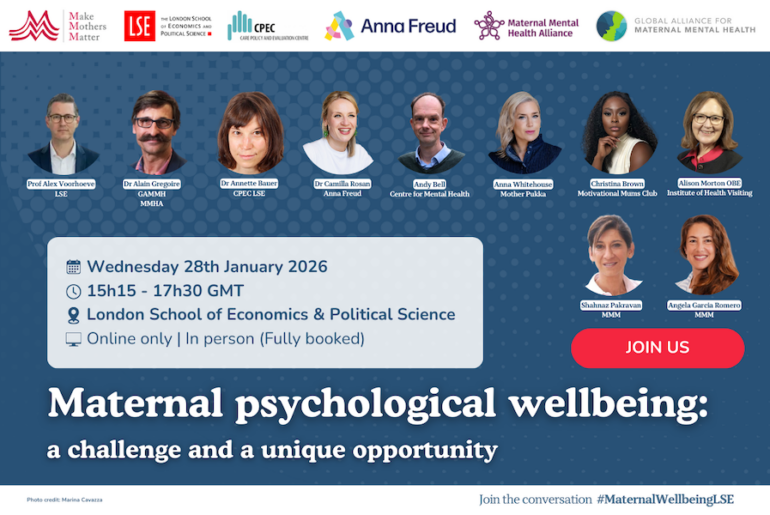
Maternal Psychological Wellbeing: A Challenge and a Unique Opportunity
13.01.26
Wednesday 28 January 2026 | 15:15 – 17:30 GMT London School of Economics & Political Science (LSE) – Live broadcast #MaternalWellbeingLSE Maternal mental health is one of the most pressing

Climate Change: A Maternal Physical and Mental Health Emergency
13.11.25
In the lead-up to the UN climate change conference in Belem, Brazil (COP30), MMM was delighted to collaborate with Dr. Saravanan Thangarajan, a Visiting Scientist & Faculty member at Harvard
Democracy on Hold: The Hidden Penalty for Parliamentarians Who Become Mothers
27.11.25
The European Parliament adopted a legislative resolution on the amendment of the European Electoral act, allowing Members to vote in plenary by proxy voting during pregnancy and after giving birth.