Financing for development matters for mothers
05.07.25
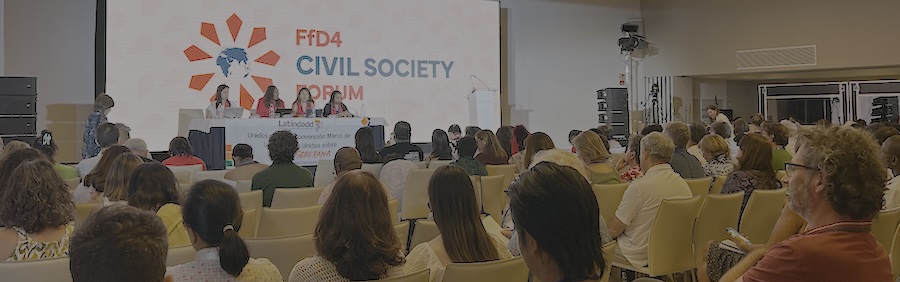
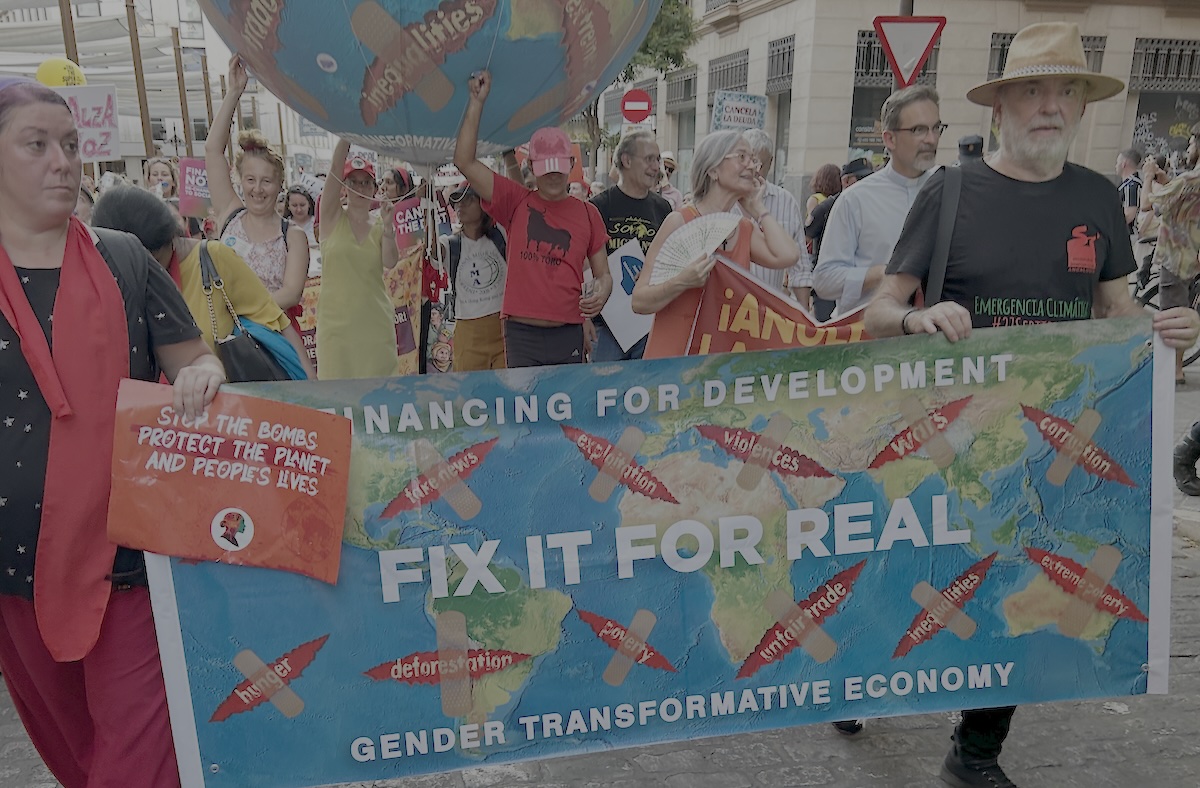
Following the 4th International Conference on Financing for Development (FfD4) in Sevilla, Spain, we explore why Financing for Development is critical for mothers around the world.
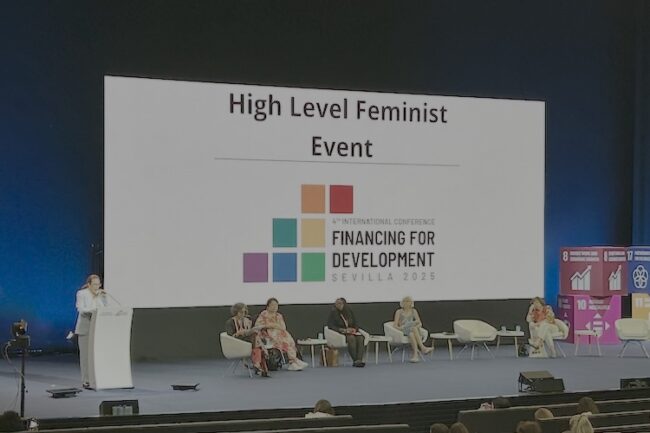
While maternity-related or women’s issues are not explicitly addressed, the topics discussed under the Financing for Development (FfD) framework have a huge impact on the lives of people, in particular women–even more so for those who are mothers.
These topics notably include taxation, debt, trade, and more generally macro-economic policies and how these impact governments’ ability to mobilise domestic resources to invest in social protection and in essential public infrastructure and services and implement SDGs–the main reasons why financing is needed.
Governments’ inability to invest in social protection and essential public infrastructures and services–including water and sanitation, electricity and energy, healthcare, education, social and care services, transportation, ICT, etc.–disproportionately impacts women who heavily rely on these public infrastructure and services:
– Women fill the gaps with their unpaid care work (e.g. to fetch water, care for a sick relative, bring a child to a distant school, etc.)
– The resulting privatisation of services like health and education make them inaccessible in particular for mothers and children
– It also reduces decent work opportunities in the public health and education sectors, again disproportionately impacting women who tend to dominate these sectors
Unfair taxation impacts mothers
At the national level, taxation systems around the world generally fail to account for the disproportionate unpaid care responsibilities and informal labour that women take on, too often reinforcing existing gender inequalities instead. Gender-blind tax systems tend to perpetuate the economic invisibility of women’s labour and widen income and wealth gaps over time.
This is particularly the case in developing countries where indirect taxation—mainly consumption (e.g. VAT) and trade taxes—often make up 60% or more of revenues, and direct taxes (e.g. income, corporate, wealth taxes) are underutilised, poorly progressive, and constrained by narrow tax bases. Low- and middle-income countries typically only collect 10–15% of GDP in total tax revenue, compared to about 34% in high-income countries.
Indirect taxation, which is prevalent in developing countries, has regressive effects, disproportionately impacting lower-income households—where women, single mothers in particular, are overrepresented.
Feminist organisations from the global South have therefore repeatedly called for the transformation of national tax systems to implement progressive taxation on income and wealth, with tax incentives or deductions for care work (e.g. childcare expenses).
At the global level, the international rules that govern taxation have also been inadequate and unfair for developing countries. Typically, multinationals use gaps in tax regulations to shift their profits to low or non-tax locations. As a result, developing countries lose much needed revenues from tax avoidance, tax evasion and illicit financial flows, again with a disproportionate impact on women.
But there is hope. Pushed by developing countries and in spite of opposition from developed countries, on the road to FfD4, work on a UN framework convention on international tax cooperation was launched in 2024, and negotiations are under way to reform the current international tax system. This is a very important step towards a fairer, more inclusive and effective international tax system.
MMM has joined other feminist organisations to follow its development and ensure that a gender lens is taken in the drafting of this new treaty.
The debt crisis exacerbates inequalities
Today, more than 3.4 billion people live in countries that spend more on debt interest payments than on health or education. Debt costs remain disproportionately high in developing countries who face higher interest rates. As a result, 61 countries allocated more than 10% of their government revenues to debt interest in 2024, diverting resources for much-needed development spending.
High levels of sovereign debt generally translate into austerity measures, whereby public services and social protection are cut to manage debt. Women—especially mothers, and even more so when they are single—often bear the brunt of these austerity measures, which increase their caregiving work and restrict access to healthcare, education, and social support. Feminist organisations have long denounced the structural adjustment programs and loan conditionalities from international financial institutions like the IMF that impose austerity as undermining gender equity.
The effects of the debt crisis are further exacerbated by a general decrease of overseas development assistance (ODA). Not only have developed countries long failed to deliver on their commitment to dedicate 0.7% of their GDP to ODA, but ODA decreased by 9% in 2024 and the OECD estimates that it will further decrease by 9 to 15% in 2025.
Trade agreements are not gender neutral
Trade policies and global trade agreements also impact women’s economic opportunities and vulnerabilities. While international trade can create jobs for women, especially in export-oriented industries like textiles and agriculture, these are often characterised by low wages, poor working conditions, and limited rights. Trade liberalisation may increase competitiveness, but it can also drive informalisation of labour, disproportionately affecting women who lack legal and social protections. Furthermore, trade policies rarely include gender impact assessments, which means their unintended consequences on women’s economic security are largely unaddressed.
For trade to be truly inclusive, women’s voices must be part of the policy-making processes, and trade frameworks need to integrate gender considerations, including care-related aspects, from the outset.
 Share
Share Share
Share Print
Print Email
Email
Maternal Psychological Wellbeing: A Challenge and a Unique Opportunity
13.01.26
Wednesday 28 January 2026 | 15:15 – 17:30 GMT London School of Economics & Political Science (LSE) – Live broadcast #MaternalWellbeingLSE Maternal mental health is one of the most pressing

Climate Change: A Maternal Physical and Mental Health Emergency
13.11.25
In the lead-up to the UN climate change conference in Belem, Brazil (COP30), MMM was delighted to collaborate with Dr. Saravanan Thangarajan, a Visiting Scientist & Faculty member at Harvard
Democracy on Hold: The Hidden Penalty for Parliamentarians Who Become Mothers
27.11.25
The European Parliament adopted a legislative resolution on the amendment of the European Electoral act, allowing Members to vote in plenary by proxy voting during pregnancy and after giving birth.