Mouvement Mondial des Mères au Liban

Mouvement Mondial des Mères au Liban was established following the Conference that MMM organised in October 2013 in Beirut, Lebanon on “The role of women in building Peace and Security”.
“The conference really opened our eyes; it gave us the desire to meet together, women and mothers from the different communities of Lebanon, to do something constructive together to promote education, family and peace… We want to form Mouvement Mondial des Mères au Liban.”
Organisations working with Mouvement Mondial des Mères au Liban
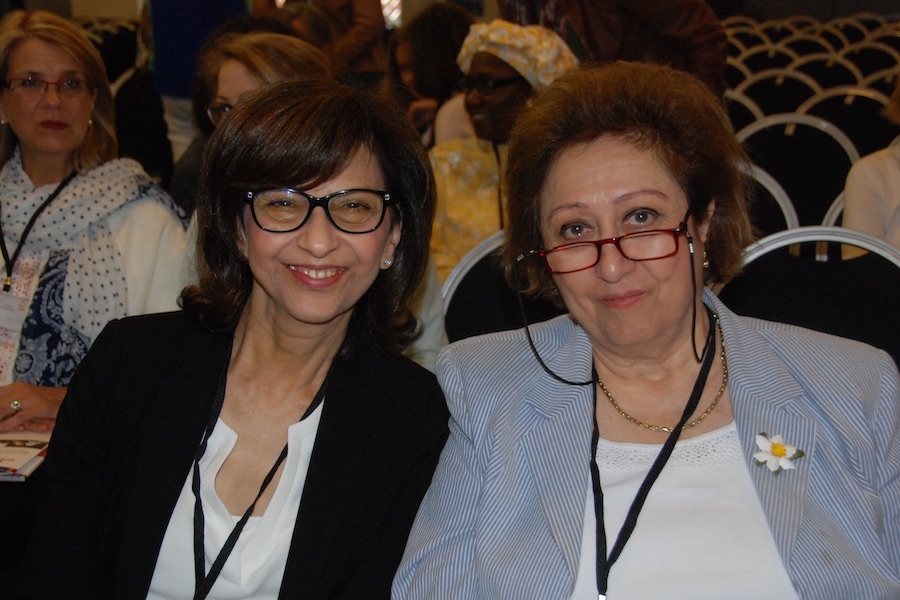
Soha Jazairi & Terrine Hasserdjian at the 2018 Mothers4Peace conference organised by MMM in Casablanca
The association federates Lebanese associations working in various parts of the country, whose activities contribute to improving the quality of life for mothers and children, advocating legislation to uphold women’s rights and gender equality… These associations are represented by their President or other Board Members.
- The Council of Lebanese women, which groups together over 170 NGOs under its aegis over the whole of Lebanese territory
- The Association of Parents with Disabled Children
- Amnesty International Lebanon
- The Association of the Ladies of Charity (AIC) Lebanon
- The Committee of Lebanese Mothers
- The Lebanese movement for ecology
- The Saint Simon Foyer
- The al-Sadr Association
- The Civil Association for Saving Children in Lebanon
- Women’s Auxiliary, Haigazian University
- The Providence Foyer
- The Association of Lebanese University Women
Mouvement Mondial des Mères au Liban organises activities and events to help them expand their networks and gain influence in their respective communities to reduce the various forms of discrimination and violence towards women and children. Its members meet regularly to exchange information and coordinate their activities.
The situation in Lebanon
The political unrest, the economic crisis and armed conflicts in Lebanon and in the neighbouring countries put a heavy strain on families. Mothers and children are the most vulnerable in this difficult context. Lebanon, a small country of 4 million inhabitants with few natural resources, is currently welcoming more than 2 million Syrian refugees as well as hundreds of thousands of refugees from other countries like Palestine, Iraq etc.
Advocacy
Mouvement Mondial des Mères au Liban encourages leaders and other stakeholders in society to recognise the contribution of mothers to economic and social development, and to better take into account their fundamental role for peace. To this end, it has organised meetings with ministers and members of parliament, particularly with those who are women.
Mouvement Mondial des Mères au Liban calls on political leaders to change the law and regulations to achieve the following objectives:
- Applying a civil code
- Allowing Lebanese women to pass on their nationality to their children
- Providing a pension and medical insurance for the elderly
- Extending maternity leave to 3 months
- Fighting against the poverty of mothers
- Lowering the voting age from 21 to 18 years old
- Introducing a quota for women in the government, parliament, local government and other public institutions
- Forbidding marriage for girls under 16
- Improving ecological and environmental issues, such as waste management and collection, and the functioning of other public services.