Local governments, key players in promoting a caring society
21.09.24
UN New York, Summit of the Future - At an event on Caring Territories for the Future: Feminist Municipalism for Equality, Climate Action, Democracy and Peace, MMM highlighted the many ways in which local governments can contribute to recognising, redistributing and supporting unpaid care work, and the mothers behind it.
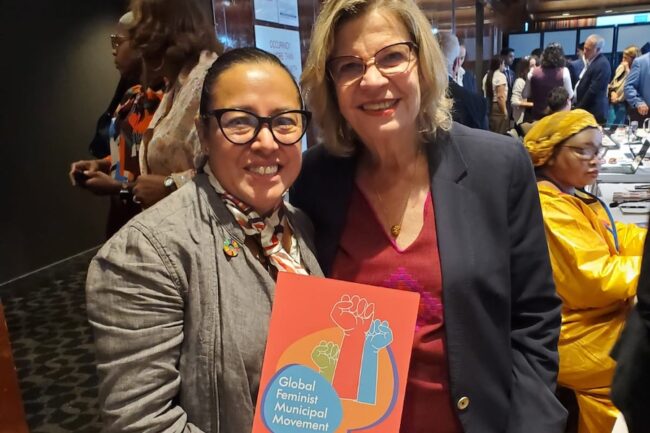
Organised by United Cities and Local Governments (UCLG), UN Women and the government of Mexico, the event celebrated Local and Regional Governments Day on 20 September, ahead of the UN Summit of the future. It discussed how local and regional governments, in alliance with key partners, can advance a paradigm shift on care as a transformative lever to achieve the 2030 development agenda.
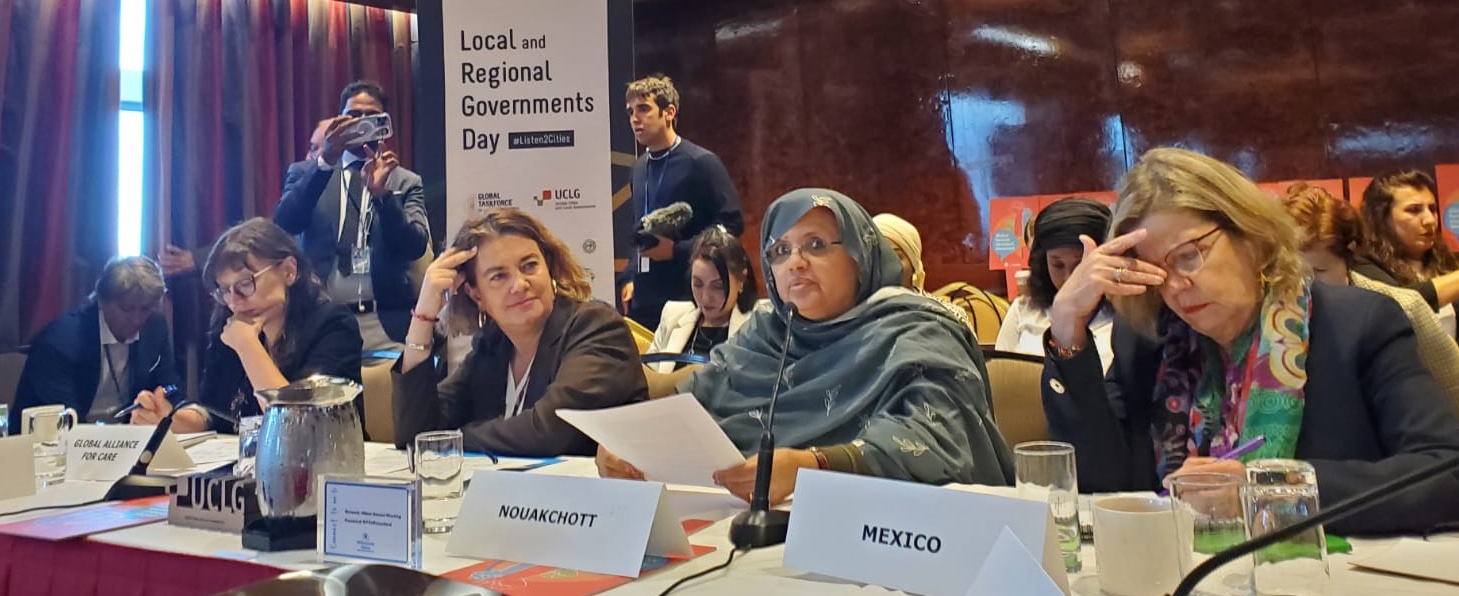
Invited to speak in the first session on a new social contract based on local caring systems, Jacqueline Leduc, MMM’s main representative to the UN in New York, highlighted the many ways in which local governments can and must be key players in developing cross-sectorial care policies.
The following summarises our key points.
Unpaid care work IS work, indispensable work, that sustains families, communities, society and the economy – and that benefits us all.
Because it benefits us all, everyone, every stakeholder, should take its share of responsibility. And that includes local governments, which can and must contribute to the recognition, redistribution and support of unpaid care work.
First of all, local governments are key stakeholders for the provision of quality public infrastructure and services supporting unpaid care caregivers, including health services, childcare and other care services, transportation, education, social housing, etc.
But local governments can and must do more in helping to develop a comprehensive care system. They can:
- Push local companies to implement family friendly policies that support caregivers – working mothers in particular
- Organise programs to promote the involvement of men/fathers in caregiving to redistribute unpaid care and domestic work more fairly within the home – existing programs have a proven track record of benefits for mothers, children and fathers alike
- Ensure that urban planning (including transportation, housing, public infrastructure, etc.) facilitates the the living conditions for unpaid caregivers and optimises their time
- Produce data to better understand the needs and realities of mothers and other unpaid caregivers, in relation to unpaid care work
- Support civil society actions – mothers centres, promoted by our associate member MINE (for Mother Centres International Network for Empowerment) is an example of good practices: mothers centres have a proven track record in empowering and connecting mothers to build caring communities across the world
- Follow the lead of the city of Bogota in Colombia, whose ‘Care Blocks’ concept is another example of good practice: the main objective is not only to bring care and other support services close to caregivers, but also to offer them opportunities for leisure, sport, education and socialisation
The principle of co-responsibility is vital when applied to local governments. They are key stakeholders in redressing the unpaid care work-related social and economic injustices suffered by women – in particular when they are mothers, and in caring for and supporting those caregivers.
By nurturing the carers and working together, we are in a position to build more caring societies, and a new social contract.
 Share
Share Share
Share Print
Print Email
Email
Maternal Psychological Wellbeing: A Challenge and a Unique Opportunity
13.01.26
Wednesday 28 January 2026 | 15:15 – 17:30 GMT London School of Economics & Political Science (LSE) – Live broadcast #MaternalWellbeingLSE Maternal mental health is one of the most pressing

Climate Change: A Maternal Physical and Mental Health Emergency
13.11.25
In the lead-up to the UN climate change conference in Belem, Brazil (COP30), MMM was delighted to collaborate with Dr. Saravanan Thangarajan, a Visiting Scientist & Faculty member at Harvard

Democracy on Hold: The Hidden Penalty for Parliamentarians Who Become Mothers
27.11.25
The European Parliament adopted a legislative resolution on the amendment of the European Electoral act, allowing Members to vote in plenary by proxy voting during pregnancy and after giving birth.