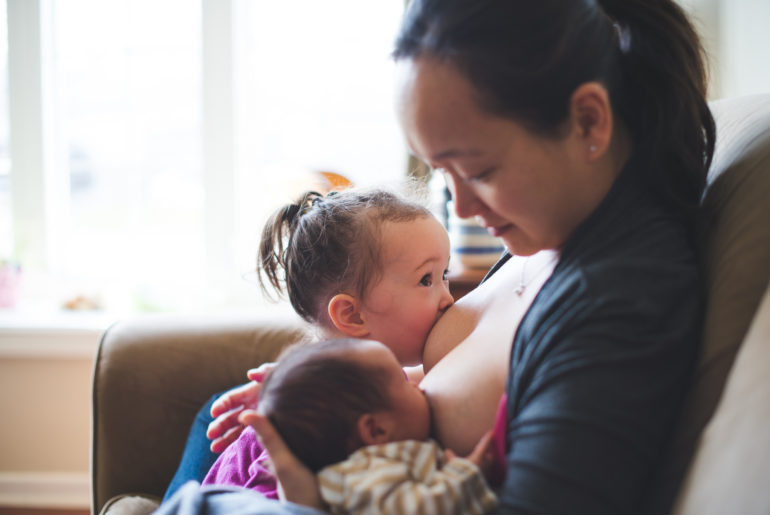
Amplifying Mothers’ Voices at the UN Human Rights Council
15.10.25
UN Geneva, Human Rights Council – The MMM Geneva team seized opportunities to shed light on the multiple human rights violations mothers face, and to call for care-centred policies, and the recognition and empowerment of mothers. Here is a look back at our participation in HRC60, which closed last week.
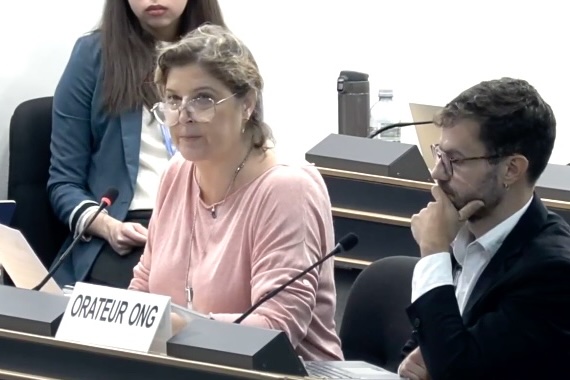
Motherhood impacts economic security in old age
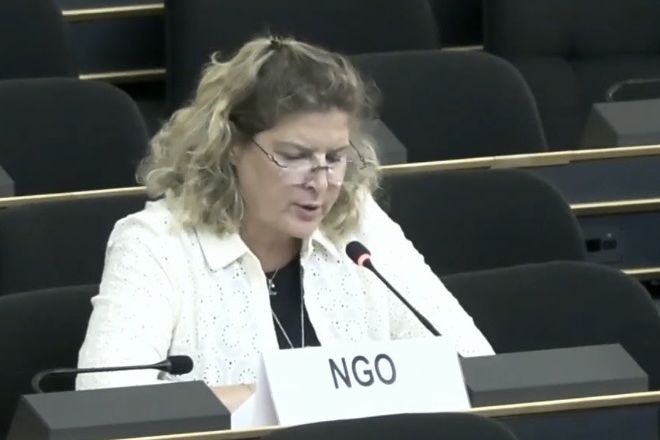
In the discussion on the rights of older persons, which focused on the intersection between older persons’ right to social protection and their right to work, we highlighted the Care gap as a root cause of inequities for older women.
The increased risk of poverty faced by older women is directly linked to a lifetime of disproportionate share of unpaid care work–including caregiving that often continues into old age, as they support older relatives or grandchildren.
We also called for recognising and addressing the specific discriminations and obstacles faced by mothers–the “motherhood penalty”, their frequently interrupted working lives, and the impact of motherhood on women’s economic security in old age.

Recognising and valuing care key to the realisation of the right to development
We welcomed the report of the Special Rapporteur on the right to development, which focused on the nexus between gender equality and the right to development. The report rightly calls for a feminist economy, one that invests in care infrastructure, values unpaid care, and ensures its equal distribution between women and men, families and society, public and private actors.
We therefore urged States to:
- Invest in cross-sectorial care systems–from quality, accessible childcare and parental leaves to universal healthcare and social protection
- Place care and mothers at the centre of national and international development strategies
Child labour directly linked to gender inequality–and mothers rights
The report of the Special Rapporteur on contemporary forms of slavery focused on child labour.
Child labour is a symptom of poverty and family vulnerability. It is also directly linked to gender inequality and mothers’ inability to participate in the Labour market. We know that when women have better education and can participate in the labour force, child labour seldom takes place.
For us at MMM, children’s rights are interconnected with mothers’ rights: preventing child labour therefore requires the economic empowerment of mothers through policies that recognise, value and support the unpaid work of caring, and redistribute this vital work more equitably, both between men and women and across society.
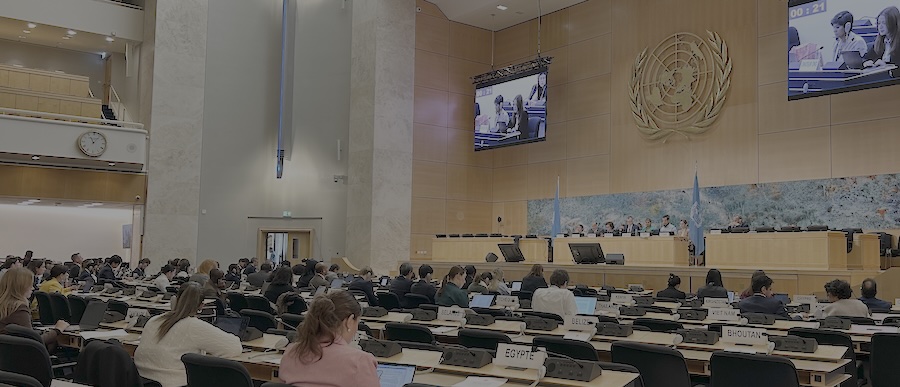
Mothers must be recognised and involved in transitional justice processes
Speaking at the panel on Strengthening gender perspectives in transitional justice processes, we highlighted the role of mothers during conflicts and called for the equal participation of women, especially mothers, in all stages of transitional justice, and transformative reparations that value care work, restore livelihoods and healthcare, uphold dignity, and address intergenerational impacts.
Mothers stand at the heart of families and communities. In times of conflict, they are caregivers, providers, and protectors, holding together the fabric of communities and society while bearing the compounded costs of violence. Their unpaid care work sustains not only survival but also resilience and recovery. Despite this, mothers remain largely invisible in transitional justice processes. […]
Recognizing mothers’ multiple roles and ensuring their rights is not only a matter of justice, but also essential for rebuilding societies, preventing recurrence, and achieving sustainable peace.
New resolution on Preventable maternal mortality and morbidity
Last but not least, we welcomed the resolution on Preventable maternal mortality and morbidity and human rights (A/HRC/RES/60/18), which was unanimously adopted by the Council. The resolution calls for renewed attention to this “major human rights issue”, recognising that it is grounded in poverty, as well as “discriminatory laws and practices, harmful gender norms and practices, a lack of functioning health systems and services, information and education, shortages of skilled health workers, a lack of access to healthcare services and necessary medicines and medical equipment, in particular in rural and remote areas and islands and the poorest urban areas, and a lack of accountability”.
Maternal mortality remains unacceptably high: according to WHO, about 260 000 women died during and following pregnancy and childbirth in 2023. That is more than 700 per day, one every two minutes. Approximately 92% of all maternal deaths occurred in low- and lower-middle-income countries, and most could have been prevented.
The resolution urges states to prioritize the elimination of preventable maternal mortality and morbidity.
The 60th session of the UN Human Rights Council took place from 8 September to 8 October 2025 in Geneva, Switzerland.
 Share
Share Share
Share Print
Print Email
Email
Maternal Psychological Wellbeing: A Challenge and a Unique Opportunity
13.01.26
Wednesday 28 January 2026 | 15:15 – 17:30 GMT London School of Economics & Political Science (LSE) – Live broadcast #MaternalWellbeingLSE Maternal mental health is one of the most pressing

Climate Change: A Maternal Physical and Mental Health Emergency
13.11.25
In the lead-up to the UN climate change conference in Belem, Brazil (COP30), MMM was delighted to collaborate with Dr. Saravanan Thangarajan, a Visiting Scientist & Faculty member at Harvard
Democracy on Hold: The Hidden Penalty for Parliamentarians Who Become Mothers
27.11.25
The European Parliament adopted a legislative resolution on the amendment of the European Electoral act, allowing Members to vote in plenary by proxy voting during pregnancy and after giving birth.