Every mother should have access to the long-term care she needs and deserves
20.04.24
In a timely joint statement, we at Make mothers Matter, along with 16 European NGOs, have urged EU policymakers to prioritise long-term care in the upcoming 2024-2029 legislature. This call comes as the Belgian presidency of the EU focuses on strengthening the European Pillar of Social Rights, with a specific emphasis on Principle 18 – the right to long-term care.
The Urgency for Action
The statement highlights several critical issues plaguing long-term care across Europe, including:
- Underinvestment : Insufficient funding for long-term care services
- Inadequate Social Protection : Lack of comprehensive support systems for both care recipients and providers
- Limited Person-Centered Care : A deficit of services that prioritise individual needs and preferences
- Staff Shortages : A growing need for qualified personnel in the long-term care sector.
These issues put pressure on a system already struggling to meet the growing demand for quality care. In the joint statement, the contributing NGOs, have formed a united front to persevere in improving this situation and ultimately, the quality of the long-term care experience within Europe.
Recommendations and Demands
The joint statement proposes several key actions to address these challenges, including, the establishment of a European Long-Term Care Platform. This platform would foster collaboration between national authorities, civil society organizations (like MMM), care providers, and social partners. By facilitating dialogue and information sharing, it would promote effective implementation of the EU’s Long-Term Care Strategy.
The statement also calls for the implementation of the Council Recommendation on Long-Term Care (2022) meaning that Member States need to develop and submit ambitious national plans by June 2024, focusing on affordability, accessibility, and quality of care.
And finally, it addresses the need for Transformational Investments. The latter, in order to shift the approach to long-term care funding, viewing it as an investment in Europe’s social and economic well-being, not just a cost.
Long-Term Care specific mothers’ demands
In addition to the joint statement common demands, we at MMM on behalf of the mothers we represent, ask for long-term care-related measures that address in a comprehensive way the particular challenges and disadvantages they encounter.
As outlined in a separate policy paper we believe that it is imperative to draw attention to the long-term care demands of women in relation to the gender pension gap. One of the primary reasons for this inequality is the time that women spend on unpaid labor activities such as care. This time is not yet recognised nor recalculated in terms of pension benefits and is a source of economic and social injustice, impacting not only the economic and financial situation of mothers and their families, but also their mental and physical health.
Therefore, we advocate for a better protection for mothers in order to prevent negative consequences later in life and also in respect to their long-term care options. As a solution, we urge the EU to:
- Implement a Care Credit System that awards pension credits for time taken to fulfill care activities at different stages of a mother’s life and to recognise and value unpaid care work in a broader sense
- Conduct a reform of the Survivor’s Pensions systems to address rising divorce rates in order to reduce the social exclusion of older women and their dependency on their (ex)husband’s pensions
- Alongside that, we believe that the promotion of Intergenerational Cohousing responds to the wish of a person-centered alternative solution in old age. Studies demonstrate that it helps lower housing costs, prevents feelings of loneliness or isolation, allows older women to remain active and in good mental and physical health
- Finally, we believe that it is necessary to revalue Part Time Work in pension calculations, increase the availability and access to Retirement Saving Plans, with a focus on predominantly female sectors, and incentivise women to actively engage in the latter.
A Call to Action
MMM calls for the implementation of a strong EU Care Strategy that includes solutions to the needs of mothers and women, a more robust and person-centered long-term care system across Europe with a women’s/mother’s lens approach and the establishment of a dedicated EU platform.
 Share
Share Share
Share Print
Print Email
Email
Maternal Psychological Wellbeing: A Challenge and a Unique Opportunity
13.01.26
Wednesday 28 January 2026 | 15:15 – 17:30 GMT London School of Economics & Political Science (LSE) – Live broadcast #MaternalWellbeingLSE Maternal mental health is one of the most pressing

Climate Change: A Maternal Physical and Mental Health Emergency
13.11.25
In the lead-up to the UN climate change conference in Belem, Brazil (COP30), MMM was delighted to collaborate with Dr. Saravanan Thangarajan, a Visiting Scientist & Faculty member at Harvard
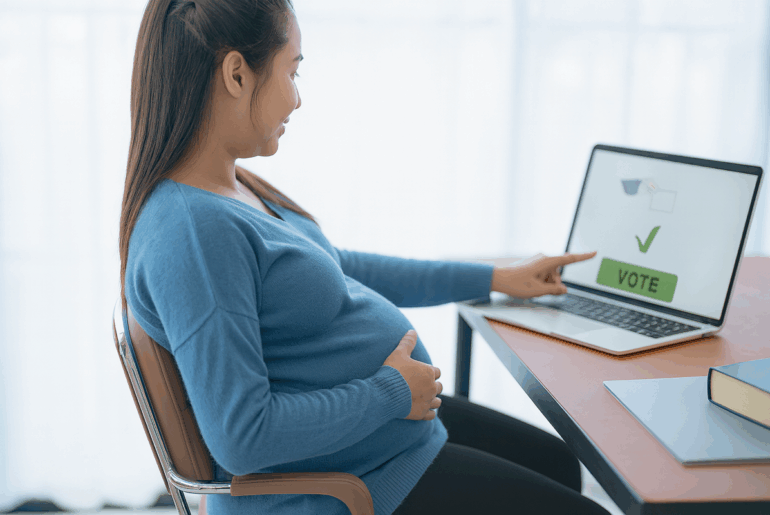
Democracy on Hold: The Hidden Penalty for Parliamentarians Who Become Mothers
27.11.25
The European Parliament adopted a legislative resolution on the amendment of the European Electoral act, allowing Members to vote in plenary by proxy voting during pregnancy and after giving birth.