Lessons learnt from the #MenLikeMe campaign
26.09.22
Our grass roots member in Canada Mothers Matter Centre launched their campaign in response to the drastic increase in Gender-Based Violence (GBV) experienced across Canada during the COVID-19 pandemic. In March 2022 we covered the story and now feature a follow up look at the lessons learnt from the campaign.

Written by Yusra Qadir (Senior Director, MMC), Marija Robinson (Coordinator, MMC) and Kate Bojin (Director of Programs, White Ribbon Canada)
The Mothers Matter Center (MMC) developed its Violence Against Women (VAW) project to address the increase in gender-based violence. With already vulnerable women at a higher risk of experiencing first-time or increased violence, we sought to address VAW differently.
The campaign took an innovative approach toward ending GBV. Rather than targeting women, ‘Men Like Me’ focused on engaging men to reinforce positive ideas of masculinity and to highlight that violence does not mean strength. The rationale was that creating meaningful change, and preventing GBV, could not remain the sole responsibility of women. Such an approach would once again place the onus on women without addressing the root cause – the behavior and perceptions of men and boys.
The ‘Men Like Me’ campaign emphasized men’s critical role in preventing and ending GBV and enabled men and boys to access services to enhance their awareness about GBV and step up as allies and supporters of women to prevent and end GBV. The ‘Men Like Me’ campaign aligns with the ongoing work White Ribbon is leading, providing training, support and coaching with immigrant and refugee men and youth to become ‘Aspiring Allies’ in preventing domestic violence.
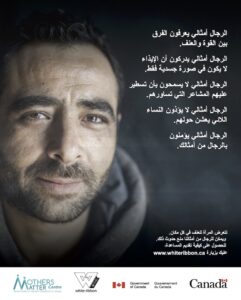 The messaging materials promoting ‘Men Like Me’ included an infographic and poster, both available in English, French, Spanish, Pashto, Dari, and Arabic, and a promotional video. Manifest communications was the partner for designing the messaging materials.
‘Men Like Me’ targeted men within different cultures across Canada and was featured on various ethnic media channels including Toronto Hispano, the Canada Latin Channel, the Canadian Arab Network, Euforia TV, Connect FM, Montreal Arabic, Hala Canada, Toronto Caribbean News, the Bengali Times, Canadian Immigrant, Eco Latino, Desi News. It was also shared by other like minded organizations like Equimundo (formerly Promundo-US), and organizations working with newcomers and immigrants in Canada.
The social media campaign ran for 60 days, from February 1st through to March 31st, 2022, at the cost of $88 per day and reached over 84,000 men across Canada and had over 628,000 impressions. Approx. 17,000 men clicked through to access the resources available on White Ribbon’s website. 91% of the men who accessed these resources were between the ages of 18 to 34, with the remaining 9% aged 35 to 44.
Some of our key learnings include:
- Most men came across ‘Men Like Me’ on Instagram. Considering we were targeting a younger male audience, this highlights how younger demographics spend more time on Instagram versus Facebook
- The younger demographics tend to engage with social media through their phones. Those who saw the campaign materials on Facebook mainly used a computer, whereas Instagram users viewed the campaign on their phones. Going forward for future campaigns, depending on the intended demographic, we will tweak the channels used for dissemination to ensure more targeted outreach, and design messaging materials according to what works best on the targeted social media channel
- It is important (and effective) to use a strength-based approach when engaging men and boys. Excluding men from conversations or looking at them as just perpetrators is counter productive. When men and boys join hands to prevent and end GBV, they show commitment, bring valuable insights and ownership, and break various stereotypes that limit men to certain harmful aspects of masculinities
- The success of the campaign and resultant engagement shows that there is interest in behavior change communication and accessing services amongst younger men and boys. There is also an appetite for meaningful engagement. Therefore, more holistic programming that engages all stakeholders (women and girls, men and boys and communities as a whole) is necessary
- We also learnt that strategic partnerships between organizations that serve women (like Mothers Matter Centre) and men (like White Ribbon) are useful and enhance the impact of initiatives aimed at preventing and ending GBV
The MMC’s VAW project was funded through Immigration, Refugees, and Citizenship Canada (IRCC) and Women and Gender Equality Canada (WAGE).
 Share
Share Share
Share Print
Print Email
Email
Europe Must Listen to Mothers: Our landmark report heads to the European Parliament
28.08.25
On 22 September 2025, the voices of mothers will take centre stage in Brussels. For the first time, Make Mothers Matter (MMM) will present its State of Motherhood in Europe
Belgian Mothers Face Alarming Rates of Burnout and Perinatal Depression, New EU Survey Finds
03.07.25
Belgian mothers are facing a mental health crisis. According to the State of Motherhood in Europe 2024 survey by Make Mothers Matter (MMM) and Kantar, Belgium reports the highest rates

Parental Mental Health Takes Centre Stage at the French National Assembly
02.04.25
Paris, France – On April 2nd, Make Mothers Matter was honoured to have key findings from its State of Motherhood in Europe 2024 report cited at the French National Assembly