MMM welcomes first ever Human Rights Council resolution on Care
11.10.23
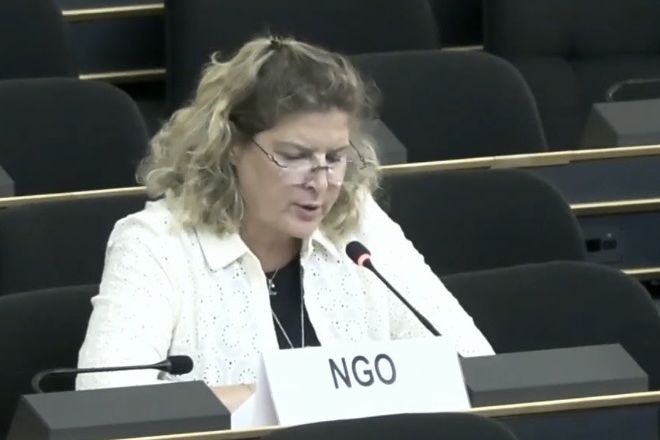
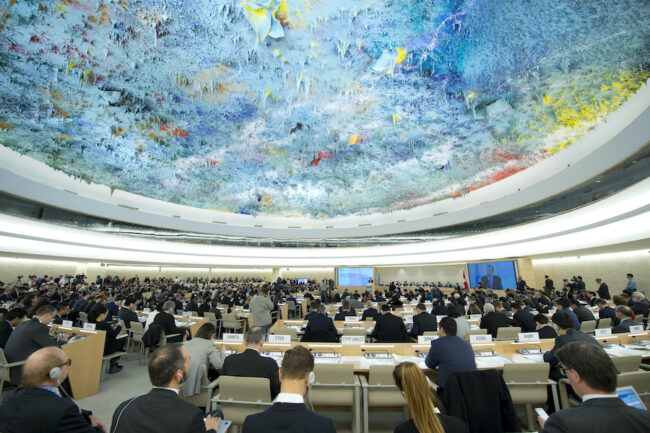
UN Geneva, Human Rights Council - Entitled ‘Centrality of care and support from a human rights perspective’, this landmark resolution was presented by the governments of Argentina, Iceland, Mexico and Spain, with 27 additional co-sponsors from Europe and Latin America joining the core group in the course of the negotiations. It was adopted by consensus without a vote at the end of the 54th session of the Human Rights Council.
Notably, the resolution recognizes that ‘an equal and fair distribution of care is a prerequisite to ensuring that women fully enjoy, on an equal basis, economic, social and cultural rights, […] and civil and political rights’. It makes it clear that women’s rights and gender equality will not be realized if the issue of the inequitable distribution of unpaid care work is not addressed.
It also stresses the importance of redistributing care responsibilities, not only within families, but also ‘among families, communities, the private sector and States’, something we at MMM have long advocated for, establishing the principle of co-responsibility.
But this comprehensive resolution goes much further. In addition to its title which is explicit on the ‘centrality of Care and support from a human rights perspective’, its contents show how Care connects to most if not all human rights – and that it is not only about women.
In other words, Care is framed as a cross-cutting issue, not just a women’s issue – and something that concerns us all as both care recipients and caregivers, and must be addressed by governments.
This is the spirit of this resolution as we understand it, and we want to express our gratitude and appreciation to the missions of Argentina, Iceland, Mexico and Spain for their leadership, and for all the work involved in the drafting and the negotiations.
→ Read the draft resolution as presented and adopted on 11 October 2023 by the 54th Session of Human Rights Council
 Share
Share Share
Share Print
Print Email
Email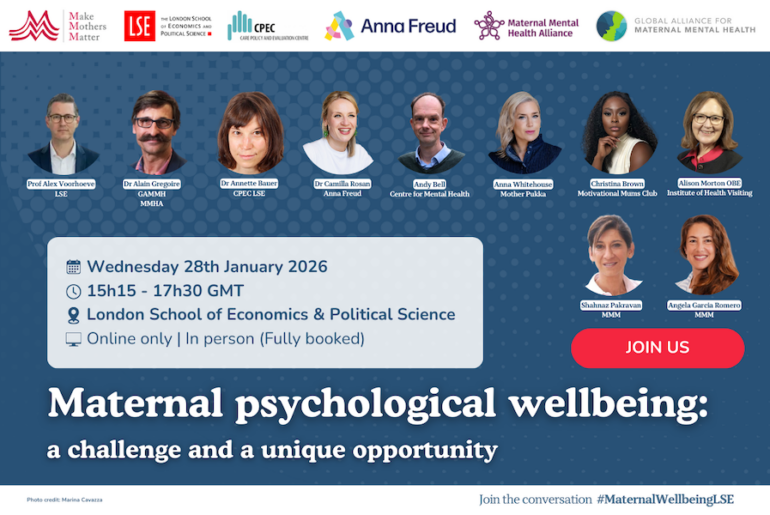
Maternal Psychological Wellbeing: A Challenge and a Unique Opportunity
13.01.26
Wednesday 28 January 2026 | 15:15 – 17:30 GMT London School of Economics & Political Science (LSE) – Live broadcast #MaternalWellbeingLSE Maternal mental health is one of the most pressing

Climate Change: A Maternal Physical and Mental Health Emergency
13.11.25
In the lead-up to the UN climate change conference in Belem, Brazil (COP30), MMM was delighted to collaborate with Dr. Saravanan Thangarajan, a Visiting Scientist & Faculty member at Harvard
Democracy on Hold: The Hidden Penalty for Parliamentarians Who Become Mothers
27.11.25
The European Parliament adopted a legislative resolution on the amendment of the European Electoral act, allowing Members to vote in plenary by proxy voting during pregnancy and after giving birth.