Tackling Child Poverty Means Supporting Parents: Olivier De Schutter’s Call to Action
11.11.25

The United Nations Special Rapporteur on extreme poverty and human rights, Olivier De Schutter, has submitted his updated contribution to the European Commission’s consultation on the EU Anti-Poverty Strategy, calling for a stronger human-rights approach to tackling poverty that reaches those most affected, among them, single parents, mothers and children across Europe.
Building on his previous statement of October 2024, De Schutter identifies six key areas for action:
- Effective participation of people in poverty as an opportunity to co-design solutions
- Expanding access to social services
- Securing adequate funding of social services
- Strengthening the European Child Guarantee
- Social mainstreaming: assessing impacts on poverty and inequalities across all EU policies
- Reinforcing national anti-poverty strategies grounded in human rights
Across the European Union, more than 94 million people remain at risk of poverty or social exclusion. For De Schutter, this is not an accident of economics but the result of choices. He argues that poverty must be addressed through rights-based policies such as fair wages, adequate social protection, and access to quality services and through the participation of those living the reality of deprivation.

Breaking the cycle of child poverty and supporting parents
The persistence of child poverty in Europe is, as De Schutter notes, “both morally unjustifiable and economically irresponsible.” He highlights how certain policies can deepen inequality, such as in Finland, where limiting access to early childhood education for children of unemployed parents or those on maternity, paternity, or parental leave was found discriminatory. These families, often single parent households led by women, are precisely those most in need of support.
De Schutter highlights the European Child Guarantee as an opportunity to change this reality for families, especially single-parent households and those in precarious work, by ensuring free, high-quality early education and care. He stresses that poverty must also be tackled through better employment conditions and predictable work schedules, since instability directly harms children’s development and family life.
“The adoption of the European Child Guarantee provides a spectacular acknowledgement that we cannot combat child poverty without also providing support to the parents.”
Olivier De Schutter, UN Special Rapporteur on extreme poverty and human rights
Conclusion
De Schutter warns that fiscal rules must not limit investment in social protection, reminding the EU that social spending is an investment in the future, not a cost to be cut. Adequate and affordable support for families is a cornerstone of parents’ and children’s well-being and rights. This vision aligns with Make Mothers Matter’s call to place care work and the lived realities of mothers and their families at the heart of policymaking.

Read the full contribution by Olivier De Schutter here.
 Share
Share Share
Share Print
Print Email
Email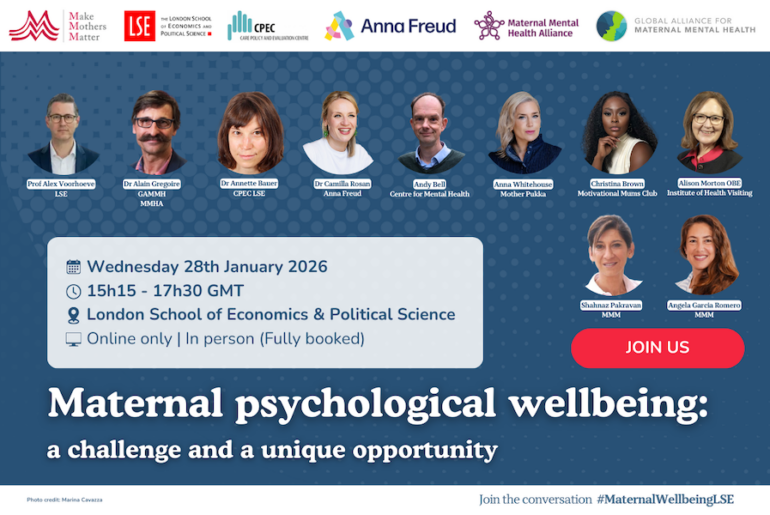
Maternal Psychological Wellbeing: A Challenge and a Unique Opportunity
13.01.26
Wednesday 28 January 2026 | 15:15 – 17:30 GMT London School of Economics & Political Science (LSE) – Live broadcast #MaternalWellbeingLSE Maternal mental health is one of the most pressing

Climate Change: A Maternal Physical and Mental Health Emergency
13.11.25
In the lead-up to the UN climate change conference in Belem, Brazil (COP30), MMM was delighted to collaborate with Dr. Saravanan Thangarajan, a Visiting Scientist & Faculty member at Harvard

Democracy on Hold: The Hidden Penalty for Parliamentarians Who Become Mothers
27.11.25
The European Parliament adopted a legislative resolution on the amendment of the European Electoral act, allowing Members to vote in plenary by proxy voting during pregnancy and after giving birth.