Maternal Psychological Wellbeing: A Challenge and a Unique Opportunity
13.01.26
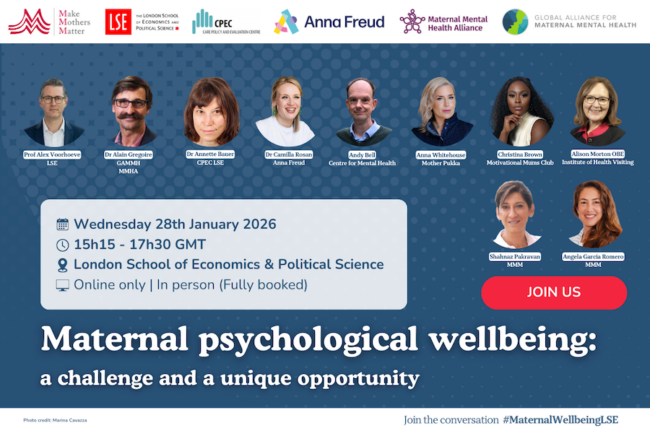
Wednesday 28 January 2026 | 15:15 – 17:30 GMT
London School of Economics & Political Science (LSE) – Live broadcast
#MaternalWellbeingLSE
Maternal mental health is one of the most pressing - and most overlooked - public health challenges of our time. It affects women, children, families, workplaces and economies. Yet it also represents a powerful opportunity: to intervene early, reduce long-term harm, and build fairer, more effective systems of care.
👉 Register here for online participation
📄 For download:
– Full Programme
– Speakers’ Bios
– Background Brief
On 28 January 2026, Make Mothers Matter (MMM), in partnership with the London School of Economics and Political Science (LSE), Anna Freud, and the Care Policy and Evaluation Centre (CPEC) at LSE, will convene policymakers, health professionals, researchers, civil society and the media for a timely and solutions-focused event on maternal psychological wellbeing.
What mothers are telling us: the UK picture
Our landmark report, The State of Motherhood in Europe 2024, is based on a study conducted by Kantar and commissioned by MMM, of 9,600 mothers across 11 EU countries and the UK.
The findings reveal the pressures facing mothers in the UK:
- 71% of mothers in the UK report feeling overloaded (compared with 67% across the EU countries surveyed)
- 47% say they have experienced mental health issues, and
- 25% report suffering from depression, higher than the European average
- 31% say motherhood has negatively impacted their careers
These figures reflect structural challenges facing mothers in the UK: unequal caregiving responsibilities, lack of recognition of care work, stigma around mental health, and fragmented systems of support. They highlight an urgent need for change – and the consequences of inaction.
Integrating mental health into maternity care: a practical solution
The event will also mark the launch of a new Anna Freud report, a mental health charity for children, young people and families, calling for more integration between mental health and universal services, including maternity and health visiting. It argues that women with common mental health difficulties, such as anxiety and depression, face a gap in support, and more integration – where professionals work together across disciplines and organisational boundaries – would close this gap through more effective and efficient care. The report documents the strong support for this improvement in care from multiple stakeholders in the UK.
This will be complemented by research from CPEC at LSE, demonstrating that integrated perinatal mental health care is not only effective but economically sound, reducing long-term costs linked to poor perinatalmaternal mental health and intergenerational harm.
Together, the evidence aligns closely with recent WHO guidance and provides a compelling case for reforming maternity care and other universal care in the UK.
A critical moment for reform in the UK
The UK is at a pivotal moment. The Government’s current review of maternity services presents a rare opportunity to deliver genuine transformation.
By committing to a holistic NHS maternity care model that integrates mental and physical health, the UK could become a global leader – fully responding to WHO guidance, robust research evidence, and the long-standing demands of women, families and professionals.
At a time of crisis in maternity services, integration offers a way forward: a system that is more sensitive, supportive, skilled and sustainable.
Bringing stakeholders together to drive change
This hybrid event will bring together senior policymakers, NHS and professional bodies, maternal and perinatal mental health organisations, researchers, foundations, media, influencers and voices with lived experience.
The event will open with contributions from Professor Alex Voorhoeve, LSE Vice President and Pro Vice Chancellor, followed by presentations from:
- Angela Garcia, Director of Projects at Make Mothers Matter, presenting the UK findings from The State of Motherhood in Europe 2024 Report
- Dr Annette Bauer, Care Policy and Evaluation Centre (CPEC), LSE, presenting economic evidence on integrated perinatal mental health care
- Dr Camilla Rosan, Consultant Perinatal Clinical Psychologist and Clinical Research Lead at Anna Freud, presenting the Centre’s new report, which calls for more integration between mental health and universal services, including maternity and health visiting, to improve the wellbeing of the whole family
The panel discussion will be moderated by Dr Alain Gregoire, consultant perinatal psychiatrist and founder of both the Global Alliance for Maternal Mental Health and the UK Maternal Mental Health Alliance.
Panelists include:
- Anna Whitehouse: Journalist, campaigner, influencer, mother and the founder of Mother Pukka
- Andy Bell, Chief Executive, Centre for Mental Health
- Christina Brown, Founder and CEO of The Motivational Mums Club, health equity expert and advocate with lived experience
- Alison Morton, Chief Executive, Institute of Health Visiting
From evidence to action
For MMM, this event is about more than presenting data. It is about turning evidence into action.
By bringing together survey findings, lived experience, clinical expertise and economic research, we aim to:
- Raise awareness of the systemic drivers of poor maternal mental health
- Promote practical, evidence-based solutions
- Encourage concrete commitments to policy and service reform
- Strengthen collaboration across sectors
- Advance research and recognition of motherhood as a societal issue
The challenges facing mothers are real – but so is the opportunity to do better.
On 28 January 2026 at LSE, we invite all those with the power to influence change to join us in shaping a maternity care system that truly supports mothers, babies and families.
👉 Register here for online participation
 Share
Share Share
Share Print
Print Email
Email
Climate Change: A Maternal Physical and Mental Health Emergency
13.11.25
In the lead-up to the UN climate change conference in Belem, Brazil (COP30), MMM was delighted to collaborate with Dr. Saravanan Thangarajan, a Visiting Scientist & Faculty member at Harvard

Democracy on Hold: The Hidden Penalty for Parliamentarians Who Become Mothers
27.11.25
The European Parliament adopted a legislative resolution on the amendment of the European Electoral act, allowing Members to vote in plenary by proxy voting during pregnancy and after giving birth.

State of Motherhood in Europe – key findings presented at the Congress of Women in Poland
31.10.25
Katowice, September 2025 — The State of Motherhood in Europe report was officially launched in Poland during the