Hidden in Plain Sight: The Mental Health Crisis Facing Young Mothers in Europe
14.03.26
UN Geneva – An MMM submission to the OHCHR call for input on the impact of mental health challenges on the enjoyment of human rights by young people highlights a critical, often overlooked human rights issue: the severe impact of mental health challenges on young mothers. Drawing on the MMM's State of Motherhood in Europe survey conducted across 12 countries, it shows that early motherhood is not just a life event but a period of structurally heightened vulnerability.

The Scale of the Problem
While half of all mothers surveyed reported experiencing mental health problems, the figures are significantly higher for younger women. Nearly 70% of mothers aged 18–24 reported mental health difficulties, compared to 59% of those aged 25–29 and 50% of the overall population of mothers.
These challenges stem from a convergence of psychological distress, economic dependency, unfinished education, and social isolation.
Human Rights and Intergenerational Impact
The consequences extend far beyond the individual.
Untreated maternal mental health issues can undermine a woman’s right to work, study, and live with dignity. In severe cases, they can be life-threatening, with suicide remaining a leading cause of maternal death in the first postnatal year in many developed countries.
Furthermore, these challenges create a ripple effect: children of mothers experiencing mental health problems are twice as likely to face social and emotional development difficulties, perpetuating cycles of inequality.
Barriers to Care
Young mothers face unique obstacles, including:
- Stigma and isolation: judgment from peers and family, particularly for unmarried mothers
- Developmental conflict: navigating the transition to adulthood while managing the demands of caregiving
- Systemic gaps: a lack of age-disaggregated data and policies that fail to address the specific needs of this demographic
A Call for Integrated Action
MMM calls for a paradigm shift from fragmented, age-neutral approaches to integrated, life-course strategies.
We call upon governments to integrate psychological support into universal maternal health services, mandate training for medical professionals, and address social determinants such as poverty.
Investing in young mothers is cost-effective; untreated maternal mental illness costs the UK alone an estimated £8.1 billion annually, with the majority of the impact borne by children – whereas improving services would cost only one fifth of this amount.
Examples of best practices already exist:
- Bogotá’s “Care blocks”: neighborhood hubs co-locating childcare, education, and mental health support
- Denmark’s “mother groups”: municipal peer-support networks that reduce isolation
- Community mothers’ centres: safe spaces fostering intergenerational support
Supporting young mothers is not merely a health issue but a matter of intergenerational justice and social cohesion. By breaking the silence and normalising support, societies can unlock the potential of both mothers and their children.
Early motherhood should not be a period of compounded vulnerability. Addressing the mental health needs of young mothers requires coordinated action across health, education, and social protection systems. Make Mothers Matter believes that supporting young mothers must become a public policy priority, as their well-being is inseparable from the long-term resilience and equity of European societies.

 Share
Share Share
Share Print
Print Email
Email
Europe Must Listen to Mothers: Our landmark report heads to the European Parliament
28.08.25
On 22 September 2025, the voices of mothers will take centre stage in Brussels. For the first time, Make Mothers Matter (MMM) will present its State of Motherhood in Europe

Belgian Mothers Face Alarming Rates of Burnout and Perinatal Depression, New EU Survey Finds
03.07.25
Belgian mothers are facing a mental health crisis. According to the State of Motherhood in Europe 2024 survey by Make Mothers Matter (MMM) and Kantar, Belgium reports the highest rates
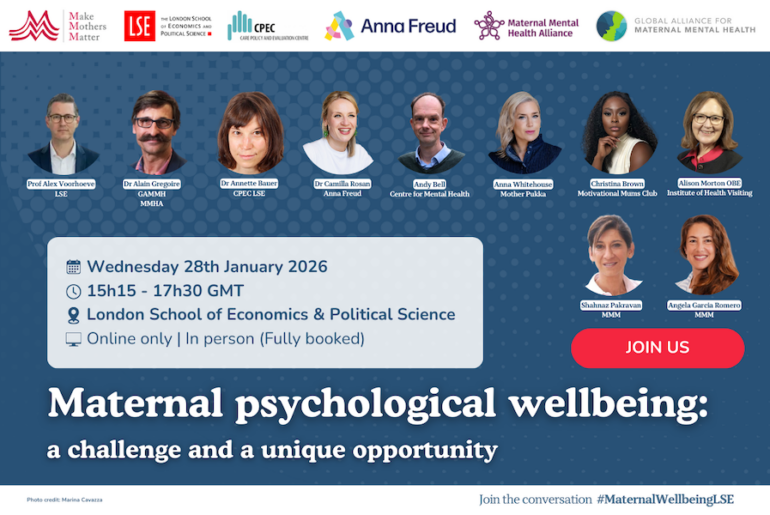
Maternal Psychological Wellbeing: A Challenge and a Unique Opportunity
13.01.26
Wednesday 28 January 2026 | 15:15 – 17:30 GMT London School of Economics & Political Science (LSE) – Live broadcast #MaternalWellbeingLSE Maternal mental health is one of the most pressing