Unlocking the Power of Care: Skills, Equity, and Social Transformation
09.01.26
UN New York – Join us online on 5th February for an official side-event to the 64th UN Commission for Social Development, which will focus on how harnessing the skills developed through the unpaid work of caregiving, in particular parenting, could pave the way for the recognition of this vital work and contribute to advancing gender equality and social development.
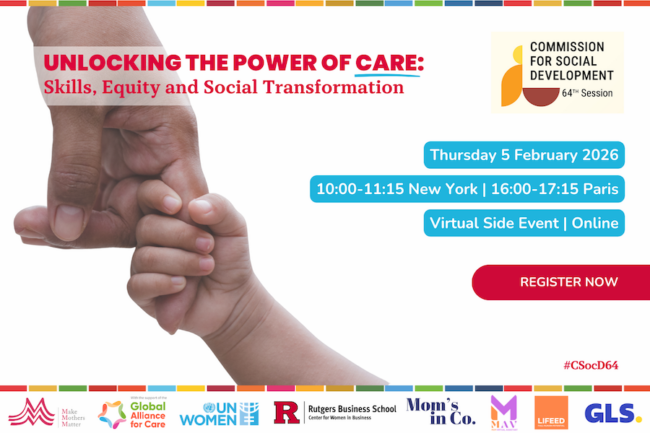
📆 Thursday 5 February
⏰ 10:00-11:15 New York | 16:00-17:15 Paris
📍 Online
👉 Register here
Background information
Unpaid care work—including child-rearing, elder care, household management, community care, etc.—provides the social foundations that allow economies and societies to function. Without this invisible labour, formal labour markets and social cohesion would collapse.
Yet, unpaid caregivers lack the recognition and support they deserve, and its inequal distribution remains a root cause of inequality and a cause for much economic and social injustice for women, in particular when they are mothers. Because it is unpaid (or underpaid) this vital work is also often discarded as unproductive and unskilled.
The reality is that care work, in particular unpaid family care work like parenting, builds a wide set of transferable skills, including organisational, managerial, relational and life skills, which are all very much in demand in the Labour market and more generally very much needed to address the multiple challenges we face.
Recognising that unpaid care work is indeed work and that it does develop skills is an important step in recognising the value of this vital work, which fuels social development.
Our side-event proposes to raise awareness about this overlooked facet of caregiving, and discuss how the recognition of these skills can be a pathway to recognising and valuing the work of caring, advance gender equality, as well as social development and social justice.
Programme & Speakers
Welcome & introduction:
- Valerie Bichelmeier, Vice-President & Head of Advocacy at the UN, Make Mothers Matter
Moderator:
- Amber Parkes, Care Economy Policy Specialist, UN Women
Panellists:
- Lisa S. Kaplowitz, Associate Professor of Professional Practice in Finance & Economics; and Co-founder and Executive Director, Rutgers Center for Women in Business (CWIB), Rutgers Business School
- Agustina Palmieri, Founder & CEO, Mom’s in Co., Spain, an MMM member organisation
- Cassandra Menga, EU Project Manager & MAV (Mom Virtual Assistant) Coordinator, Italy (video message)
- Regina Cabal, Latin America Ambassador for Lifeed; Founder Momlancers, Mexico
- Sonia Malaspina, Chief People Officer & Corporate Affairs, GLS Italy & President, Winning Women Foundation, Italy
Closing remarks:
- Ana Moreno, Technical Secretary, Global Alliance for Care
This event is organised by Make Mothers Matter as a Zoom webinar. It will be held in English with simultaneous interpretation in French and Spanish.
👉 Register here
Resources
- Research: caregiver employees bring unique value to companies, a Harvard Business Review article by Lisa Kaplowitz and Kate Mangino.
The 64th session of the UN Commission for Social Development will take place 2-12 February 2026 at the UN headquarters in New York. Priority Theme: Advancing Social Development and Social Justice through Coordinated, Equitable, and Inclusive Policies.
The Commission will also discuss as an emerging issue Eradicating Poverty and Ensuring Dignity through Resilient Care and Support Systems – a high level panel in which Farah Arabe, MMM main representative to the UN in New York and Board member, will have the honor to speak on 4th February.
See also:
→ MMM written statement to the Commission: Care, the overlooked dimension of social development and justice
 Share
Share Share
Share Print
Print Email
Email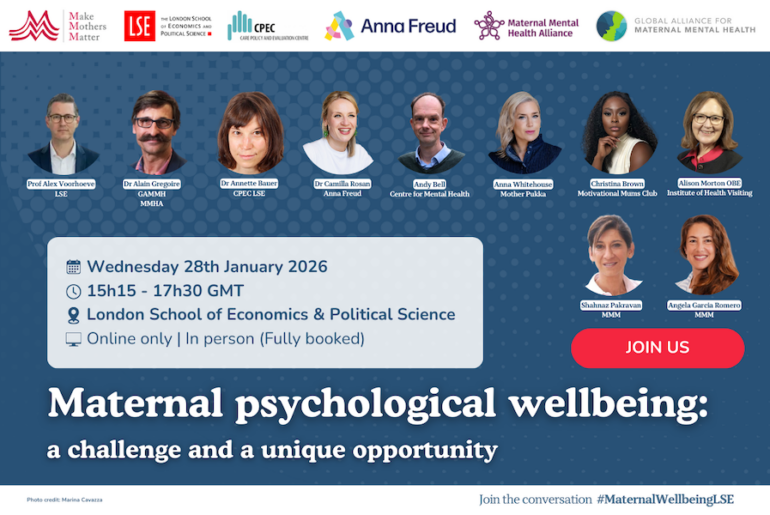
Maternal Psychological Wellbeing: A Challenge and a Unique Opportunity
13.01.26
Wednesday 28 January 2026 | 15:15 – 17:30 GMT London School of Economics & Political Science (LSE) – Live broadcast #MaternalWellbeingLSE Maternal mental health is one of the most pressing

Climate Change: A Maternal Physical and Mental Health Emergency
13.11.25
In the lead-up to the UN climate change conference in Belem, Brazil (COP30), MMM was delighted to collaborate with Dr. Saravanan Thangarajan, a Visiting Scientist & Faculty member at Harvard
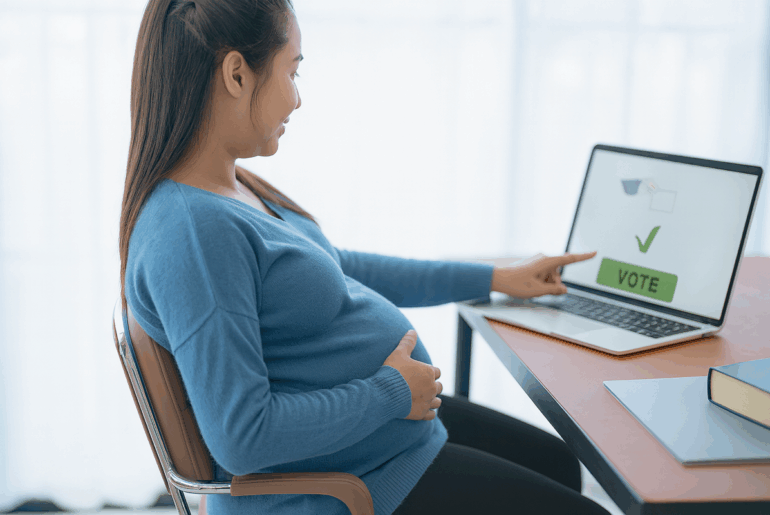
Democracy on Hold: The Hidden Penalty for Parliamentarians Who Become Mothers
27.11.25
The European Parliament adopted a legislative resolution on the amendment of the European Electoral act, allowing Members to vote in plenary by proxy voting during pregnancy and after giving birth.