Job Sharing: A Promising Solution for Working Mothers
24.03.26
By Ariane de Liedekerke, Network Co-ordinator, Make Mothers Matter
While many women are still sidelined professionally after becoming mothers, leading to a lose-lose situation, some companies are testing new ways to keep them on board, giving them the flexibility they need or want for their families, without sacrificing the business’s need for continuity.
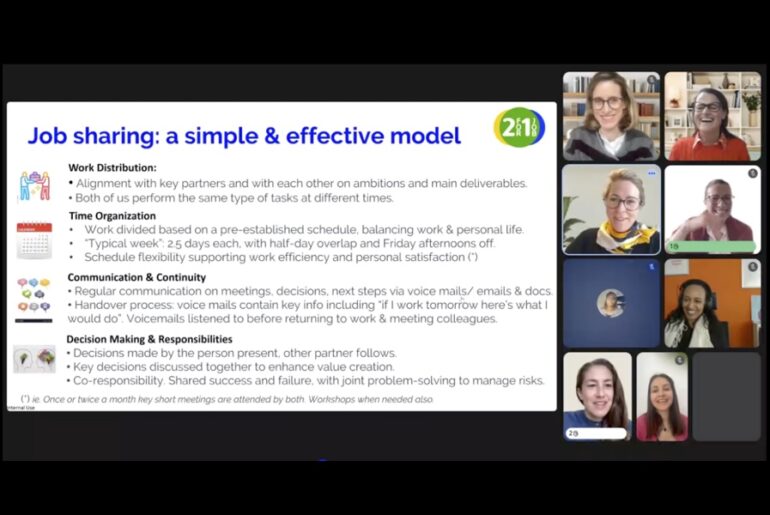
Nathalie De Wachter and Marie-Christine Moreels, a successful duo and passionate advocates of job sharing (https://www.twoforonejob.be/), were MMM’s guests for an exclusive members’ webinar on March 24, opening our minds to creative work-life balance solutions, and engaging in a great and fun conversation with attendees.
An unknown solution
A little-known but promising solution for a flexible yet rewarding professional life is job sharing. Few people are familiar with the concept, although it offers a range of benefits that seem to satisfy all parties.
Before talking about what job sharing is, let’s clarify what it is not. Job sharing is not a part-time job. Rather, it is a full-time role shared by two people who take joint responsibility and work on interdependent tasks. It maintains continuous coverage with a colleague who understands the full scope of responsibility.
This is a crucial difference with part-time work, with more advantages for all parties.
- For the employee, it enables caregivers to stay in or (re)integrate the workforce even if they cannot commit to a full-time role, allowing them to maintain professional momentum while fulfilling caregiving responsibilities. It provides continuous career progression, personal satisfaction, and the ability to engage in meaningful activities beyond work. Job shares also benefit from a coaching-like relationship, sharing identical scope but different perspectives and strengths.
- For employers, the benefits are numerous. Companies can retain talent that would otherwise be unavailable due to caregiving or other commitments. Moreover, they gain access to broader competencies—two brains for one job—and can fill difficult-to-staff positions more effectively. In addition, job sharing supports continuous project momentum and often leads to faster progress than traditional single-employee models. In addition, it provides built-in coverage for sick leave, personal leave, and other absences. Importantly, the cost of two job sharers equals the cost of one full-time employee.
- The benefits also extend to society by offering a practical solution for people who would otherwise be excluded from the workforce due to caregiving responsibilities.
Job sharing is applicable across all roles and industries. Although the benefits of job sharing are recognised once implemented, the key challenge is still that companies are unfamiliar with the concept and hesitate to try it. Education, awareness and successful examples can help build confidence and drive adoption.Currently, shared jobs are already well established in Germany and Switzerland, where one in four companies already embrace job sharing!
Key factors for success
Trust, rigor and communication are essential to successful job sharing.
A critical factor for success in job sharing is finding partners who can trust each other and jointly own responsibilities. It is key that partners openly discuss differing work styles and leverage each other’s strengths to maximise effectiveness. They will need to prioritise results over process to avoid ego conflicts and misunderstandings in decision-making. Successes are shared. Failures are shared. It’s crucial they see themselves as one team rather than opponents in moments of stress or failure. Communication is part of the solution.
Communication is essential. Job sharers need to establish clear and thorough ways of working that suit their duo. This must become a structured and consistent part of their routine to ensure that information flows seamlessly between them. For example, they might spend half a day each week together to address complex decisions, while using voice messages or brief updates to share key daily interactions. Clear channels and habits are critical to maintaining continuity.
Job sharing reveals each partner’s strengths and weaknesses clearly. Rather than viewing this as a challenge, successful pairs leverage each other’s strengths and can complement each other. For example, one partner’s superior organisational skills benefit both when managing shared files and information systems.
Job sharing represents a powerful and practical solution to balancing work and family responsibilities while maintaining professional ambition. As one participant noted, the arrangement isn’t “one plus one equals two”—it’s significantly more valuable because of the collaborative coaching dynamic and complementary strengths that emerge when two qualified professionals share responsibility for a single role.
 Share
Share Share
Share Print
Print Email
Email
Europe Must Listen to Mothers: Our landmark report heads to the European Parliament
28.08.25
On 22 September 2025, the voices of mothers will take centre stage in Brussels. For the first time, Make Mothers Matter (MMM) will present its State of Motherhood in Europe

Belgian Mothers Face Alarming Rates of Burnout and Perinatal Depression, New EU Survey Finds
03.07.25
Belgian mothers are facing a mental health crisis. According to the State of Motherhood in Europe 2024 survey by Make Mothers Matter (MMM) and Kantar, Belgium reports the highest rates

Parental Mental Health Takes Centre Stage at the French National Assembly
02.04.25
Paris, France – On April 2nd, Make Mothers Matter was honoured to have key findings from its State of Motherhood in Europe 2024 report cited at the French National Assembly