Justice must not be blind to unpaid care
08.03.26
UN New York – MMM's written statement to the 70th UN Commission on the Status of Women (CSW70) argues that access to justice for women and girls remains fundamentally incomplete because legal systems systematically ignore unpaid care work. Despite caregiving being essential to families, communities, and economies, it is rarely treated as "real labour" in legal reasoning. This omission perpetuates injustice across divorce proceedings, property division, social benefits, and employment disputes, often leaving mothers economically disadvantaged or in poverty.
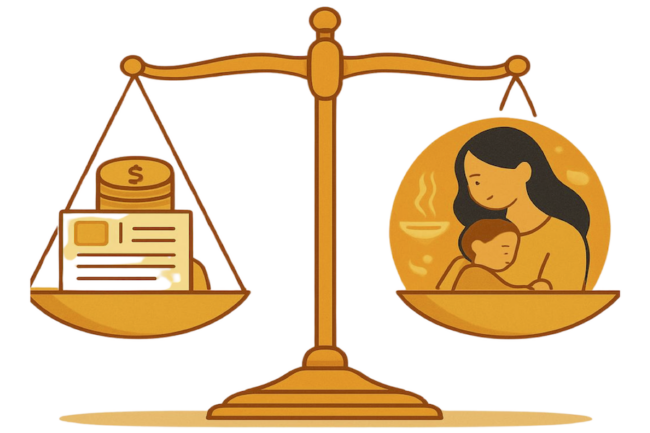
The Problem: Invisible Labour and Structural Barriers
Globally, women continue to shoulder a disproportionate share of unpaid domestic and care work, which limits their economic autonomy, educational opportunities, and public participation – in particular when they are mothers. In legal contexts, particularly during separation or divorce, courts typically prioritise monetary contributions over caregiving input.
Unpaid care is rarely accounted for in asset division, spousal support, or custody decisions. This devaluation communicates that care “does not count,” leading to economic insecurity and institutional mistrust.
These challenges are compounded by structural barriers: limited access to legal aid, lack of childcare during proceedings, and inflexible court schedules that ignore caregivers’ constraints. Women from marginalized communities – migrants, minorities, and those with disabilities – face compounded discrimination, making justice even more elusive.
International Frameworks vs. National Reality
Existing international instruments already support better justice systems for women. CEDAW General Recommendations call for legal systems to respond to gender-specific realities, recognise the economic value of unpaid care in marriage dissolution, and account for women’s unpaid contributions. Similarly, the International Covenant on Economic, Social and Cultural Rights (ICESCR) emphasizes special support for maternity and caregiving responsibilities.
However, national legal systems fall short. The World Bank’s Women, Business and the Law project reveals that women enjoy only 64% of the legal protections men do when childcare and safety indicators are included. Discriminatory laws persist: 86 economies restrict the types of jobs women can hold, 75 limit women’s asset management or inheritance rights, and 19 countries still allow husbands to legally prevent wives from working. These barriers erode women’s bargaining power in courtrooms and family disputes.
Promising Precedents: Spain and Colombia
Despite these gaps, promising reforms demonstrate what change looks like. In February 2023, a Spanish court awarded over €200,000 to a woman for 25 years of unpaid domestic and caregiving work during her marriage, calculating compensation using Spain’s minimum wage. This landmark ruling validates caregiving as a legitimate basis for financial compensation and aligns with CEDAW’s call to recognize non-financial contributions.
Additionally, framing care as a human right is gaining traction. In 2024, Colombia’s Constitutional Court recognized care as a fundamental right, and in August 2025, the Inter-American Court of Human Rights issued an Advisory Opinion, affirming care as an autonomous human right encompassing the right to care, to be cared for, and to self-care. This approach shifts care from a private responsibility to a collective one, obligating states to invest in public care infrastructure and guarantee accessible, affordable care for all.
MMM Recommendations
To strengthen access to justice for women, MMM calls on governments to:
- Reform laws to integrate unpaid care work into divorce settlements, custody decisions, and spousal support calculations
- Develop methodologies to quantify caregiving in legal terms, using international standards and precedents like the Spanish case
- Train legal professionals in gender-sensitivity and care-awareness to address existing biases
- Improve accessibility through childcare at courts, flexible hearing schedules, and expanded legal aid for unpaid caregivers
- Integrate care into justice discourse, advocating for caregiving as a central basis for rights claims
Caregiving remains legally invisible despite its fundamental societal role. If justice systems continue to ignore unpaid care work, particularly in courtrooms and legislation, justice itself remains incomplete. Legal systems must recognize caregiving as essential, dignified, and worthy of legal protection to build truly just and inclusive societies.
Justice must not be blind to unpaid care. It must see caregiving as essential, dignified, and worthy of legal recognition. Only then can we claim to build just and inclusive societies.
 Read the full statement: Submission with reference notes – UN Document
The 70th UN Commission of the Status of Women takes place 9-19 March 2026 at the UN Headquarters in New York. Its Priority theme: Ensuring and strengthening access to justice for all women and girls, including by promoting inclusive and equitable legal systems, eliminating discriminatory laws, policies, and practices, and addressing structural barriers
→ See also information on the MMM event on 11 March in New York on Parental Leave in Law and Practice: Enhancing Women’s Equity and Global Development
 Share
Share Share
Share Print
Print Email
Email
Maternal Psychological Wellbeing: A Challenge and a Unique Opportunity
13.01.26
Wednesday 28 January 2026 | 15:15 – 17:30 GMT London School of Economics & Political Science (LSE) – Live broadcast #MaternalWellbeingLSE Maternal mental health is one of the most pressing

Climate Change: A Maternal Physical and Mental Health Emergency
13.11.25
In the lead-up to the UN climate change conference in Belem, Brazil (COP30), MMM was delighted to collaborate with Dr. Saravanan Thangarajan, a Visiting Scientist & Faculty member at Harvard
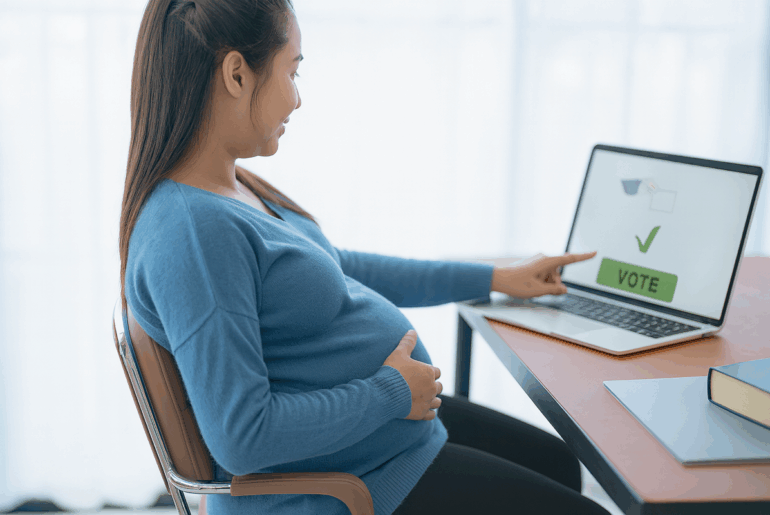
Democracy on Hold: The Hidden Penalty for Parliamentarians Who Become Mothers
27.11.25
The European Parliament adopted a legislative resolution on the amendment of the European Electoral act, allowing Members to vote in plenary by proxy voting during pregnancy and after giving birth.