MMM France presents results of first 1000 days survey – Will French mothers be heard?
21.09.21
To advocate for the needs and expectations of mothers in relation to the French government's forthcoming reform on the #1000premiersjours (#First1000Days), MMM France was determined to hear and consult them first, and launched its survey ‘Donnons la parole aux mères’ (Let's Give Mothers a Voice) in November 2020. The results were presented to local and regional policymakers at a dinner at the Versailles town hall.
This early childhood period of the first 1000 days, which starts approximately from the 4th month of pregnancy to 2 years of age, holds the foundations for the health and well-being of the individual throughout life. It is also a time when the role and well-being of mothers is critical. As Boris Cyrulnik, President of the 1000 Days Commission, points out, “To provide security for the child, we must provide security for the mother”.
More than 22,000 mothers to date have been able to express their experiences and needs regarding pregnancy, childbirth, breastfeeding, post-partum, maternity and parental leave, the place of the father, and the reconciliation of work and family life. Thanks to the fruitful collaboration between MMM France and IDM Families, the survey presents concrete figures for the first time on the needs and experiences of mothers, figures that are certified and representative as regards data processing and sampling.
The first results from 20,000 responses were presented on 3rd June 2021 during a live webinar. The recording can be viewed here.
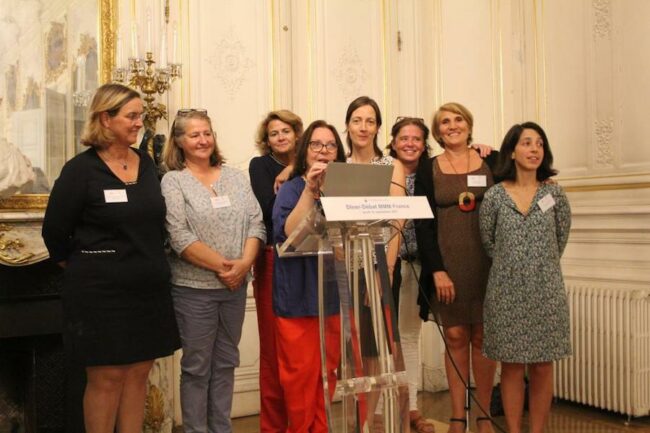
The hundred or so elected officials, association leaders and early childhood professionals gathered at a lively and friendly evening held at the Versailles town hall on Thursday 16 September, had plenty to digest when the results of the survey were presented.
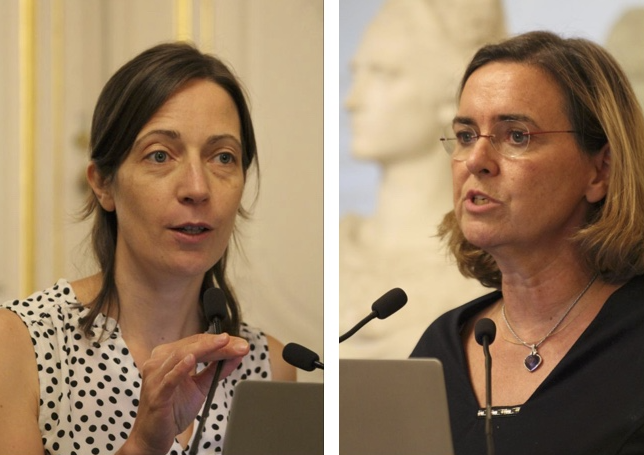
Photo above: MMMM France Laure Ferrier & Marie-Laure Gagey des Brosses presenting the results
Some key figures:
- 76% of women said their approach to childbirth changed after their first time; they would like a less clinical setting for childbirth:
93% are in favour of the creation of new birthing centres
86% in favour of integrating home births into the health care system. - A majority of women want better support:
31% of them did not feel respected by the medical team
29% of respondents have experienced obstetric violence, 13% think it is likely. - 1/3 of mothers experience post-partum depression:
For better risk prevention, they suggest longer paternity leave, better support and systematic home support during the first two months after childbirth.
Post-partum depression is more common among women who have experienced obstetric violence (46% versus 29%). - 44% of mothers said they had experienced parental burnout:
Over 80% of them want to be able to choose:
– The type of parental leave best suited to their needs: a short, well-paid parental leave versus a long, low-paid parental leave
– How to allocate this leave as they see fit within their couple
Last but not least, 96% of the 22,000 mothers surveyed by MMM France said they recognized themselves in this statement:
“Society expects me to work as if I didn’t have children and to have children as if I didn’t work.”
The survey that will underpin MMM France’s upcoming advocacy and action for mothers is still online. Help us to give a voice to mothers by sharing it with everyone you know who has lived through this period in France: ‘Donnons la parole aux mères’.
See also:
- The slides presented during the event
- The MMM France website
 Share
Share Share
Share Print
Print Email
Email
Maternal Psychological Wellbeing: A Challenge and a Unique Opportunity
13.01.26
Wednesday 28 January 2026 | 15:15 – 17:30 GMT London School of Economics & Political Science (LSE) – Live broadcast #MaternalWellbeingLSE Maternal mental health is one of the most pressing

Climate Change: A Maternal Physical and Mental Health Emergency
13.11.25
In the lead-up to the UN climate change conference in Belem, Brazil (COP30), MMM was delighted to collaborate with Dr. Saravanan Thangarajan, a Visiting Scientist & Faculty member at Harvard
Democracy on Hold: The Hidden Penalty for Parliamentarians Who Become Mothers
27.11.25
The European Parliament adopted a legislative resolution on the amendment of the European Electoral act, allowing Members to vote in plenary by proxy voting during pregnancy and after giving birth.