Beyond Breastfeeding: Recognising Mothers as Society’s First Builders
02.08.26
To mark World Breastfeeding Week, we are delighted to share this contribution from Dr. Farahdibha Tenrilemba, guest writer for Make Mothers Matter and Vice President of KOWANI, Indonesia’s oldest national women’s federation, representing nearly 90 million women. In this article, she challenges us to look beyond breastfeeding’s recognised health benefits and consider what it tells us about the invisible care work of mothers—and the need for societies to value and invest in it.
By Dr. Farahdibha Tenrilemba*
For decades, global efforts to improve maternal and child health have rightly emphasized breastfeeding as one of the most effective public health interventions. Extensive scientific evidence has demonstrated its contribution to child survival, cognitive development, maternal health, and long-term population wellbeing. Consequently, governments, international organizations, healthcare professionals, and civil society have invested considerable effort in protecting, promoting, and supporting breastfeeding.
While these efforts have generated significant progress, they have also shaped the way breastfeeding is understood. The conversation continues to be dominated by nutrition, health outcomes, and infant survival, whereas considerably less attention has been paid to what breastfeeding represents in the broader context of women’s contribution to society.
After more than two decades of working alongside mothers as a breastfeeding counsellor, public health practitioner, researcher, and advocate, I have come to believe that breastfeeding is not only a health intervention. It is also one of the earliest manifestations of motherhood’s invisible contribution to human development. It illustrates the countless forms of care, emotional labour, and responsibility that mothers undertake every day—work that sustains families and societies, yet remains largely unrecognised because it is neither formally measured nor economically valued.
Throughout these years, I have had the privilege of accompanying women during pregnancy, childbirth, and early motherhood. Regardless of their educational background, occupation, or social circumstances, I have consistently observed one common pattern. Mothers rarely questioned whether they loved their children enough. Instead, they questioned whether they were doing enough, producing enough milk, balancing work and caregiving well enough, or meeting the expectations placed upon them.
These concerns reveal something that extends far beyond breastfeeding itself.
They reveal the persistent tendency to individualise responsibility while overlooking the social environment in which mothers are expected to provide care.
Breastfeeding provides a compelling example. Public health recommendations encourage mothers to exclusively breastfeed during the first six months of life and to continue breastfeeding alongside complementary feeding thereafter. Yet the ability to do so depends
on factors that lie well beyond maternal intention. Adequate maternity protection, supportive workplaces, access to skilled health professionals, family involvement, and community acceptance all influence whether breastfeeding can be initiated and sustained successfully.
In other words, breastfeeding outcomes are not determined solely by mothers.
They are co-produced by the environments in which mothers live and work.
Recognising this shifts the conversation in an important way. Rather than asking whether mothers have fulfilled their responsibilities, we begin asking whether institutions have fulfilled theirs.
This distinction is particularly relevant at a time when many countries are investing in human capital development while simultaneously facing declining fertility, demographic transitions, and growing concerns about women’s labour force participation.
These discussions often position motherhood and economic participation as competing priorities. In reality, they
should be understood as mutually reinforcing dimensions of sustainable development.
Supporting mothers should therefore not be viewed primarily as a welfare agenda. It is an investment agenda.
Every healthy child, every capable learner, and every productive future citizen begin life dependent upon care that is overwhelmingly provided by mothers. Much of this care occurs long before formal education begins and long before it becomes visible within conventional economic indicators. Nevertheless, it constitutes one of society’s earliest and most important investments in human capability.
Indonesia illustrates both encouraging progress and continuing challenges in this regard.
During the past two decades, breastfeeding protection has been strengthened through successive legal reforms, including the evolution from the previous Health Law to Law No. 17 of 2023, Government Regulation No. 28 of 2024, and Law No. 4 of 2024 concerning Maternal and Child Welfare during the First 1,000 Days of Life. According to the World Health Organization, the proportion of infants under six months who are exclusively breastfed increased from 52 percent in 2017 to 66.4 percent in 2024, reflecting substantial national progress.
At the same time, implementation remains uneven. Many mothers continue to face challenges when returning to paid employment, particularly those working in informal sectors where maternity protection remains limited. Access to breastfeeding counselling and family support also varies considerably between communities. These realities remind us that progressive legislation, while essential, cannot achieve its intended impact without equally strong implementation and cultural support.
Perhaps this is the broader lesson that breastfeeding offers.
Its greatest significance lies not only in the health benefits it provides, but in what it teaches us about the role of mothers within society. Breastfeeding makes visible a form of work that has often been taken for granted. It reminds us that the wellbeing of children cannot be
separated from the wellbeing of those who care for them, and that societies cannot expect mothers to shoulder responsibility for future generations without recognising, supporting, and investing in the work they perform every day.
For organisations such as Make Mothers Matter, this perspective has particular relevance. Recognising mothers is not simply about celebrating motherhood. It is about acknowledging that mothers contribute to society in ways that extend far beyond the household. Their work generates public value. It strengthens communities, supports economies, and shapes future generations. Yet because much of this contribution remains invisible, it continues to be underestimated in policy, public discourse, and economic thinking.
World Breastfeeding Week therefore offers an opportunity to broaden our perspective. Rather than viewing breastfeeding solely as a health intervention, we can also understand it as a window into the wider question of how societies value mothers. The conversation ultimately extends beyond breastfeeding itself. It concerns whether we are prepared to recognise mothers not only as caregivers within families, but as essential contributors to social progress and sustainable development.
* Dr. Farahdibha Tenrilemba is a public health scholar and policy advisor whose work connects maternal and child health with broader questions of public policy, women’s leadership, maternity protection, and human capital development. Over the past two decades, she has worked across community advocacy, national policy, and international dialogue to advance systems that better support women, families, and future generations. She is the co-founder of the Indonesian Breastfeeding Mothers Association (AIMI), Vice President of Indonesia Council of Women (KOWANI), and a delegate of Women20.
 Share
Share Share
Share Print
Print Email
Email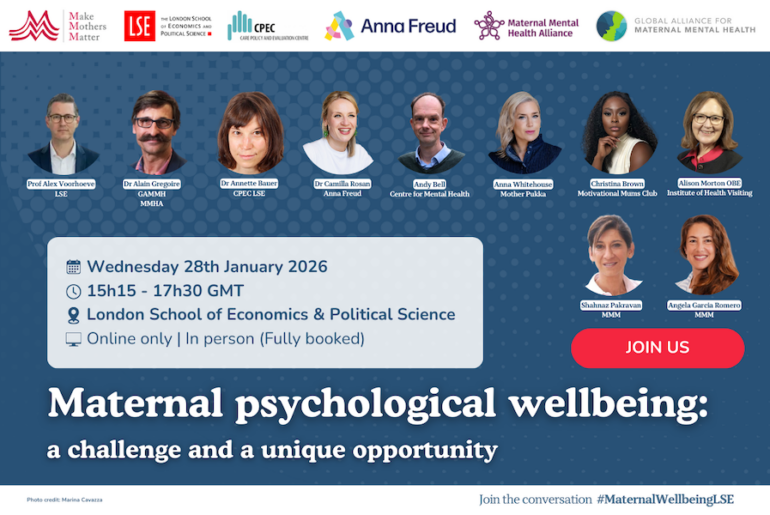
Maternal Psychological Wellbeing: A Challenge and a Unique Opportunity
13.01.26
Wednesday 28 January 2026 | 15:15 – 17:30 GMT London School of Economics & Political Science (LSE) – Live broadcast #MaternalWellbeingLSE Maternal mental health is one of the most pressing

Climate Change: A Maternal Physical and Mental Health Emergency
13.11.25
In the lead-up to the UN climate change conference in Belem, Brazil (COP30), MMM was delighted to collaborate with Dr. Saravanan Thangarajan, a Visiting Scientist & Faculty member at Harvard

Democracy on Hold: The Hidden Penalty for Parliamentarians Who Become Mothers
27.11.25
The European Parliament adopted a legislative resolution on the amendment of the European Electoral act, allowing Members to vote in plenary by proxy voting during pregnancy and after giving birth.