We call for multi-stakeholder approach to recognise and support unpaid care work
21.07.24
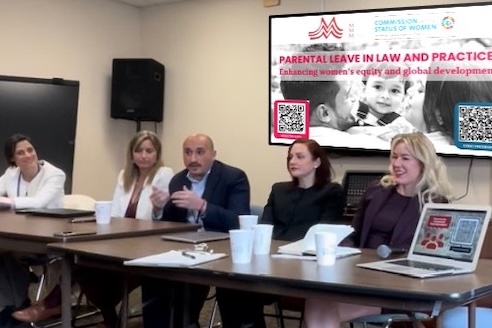
UN New York - Participating in the meeting of the UN Economic and Social Council (ECOSOC) on care and support systems, MMM reaffirmed the principle of co-responsibility, which should underpin all national care policies. In our intervention, we highlighted the key role of the private sector and grassroots NGOs working at the community level.
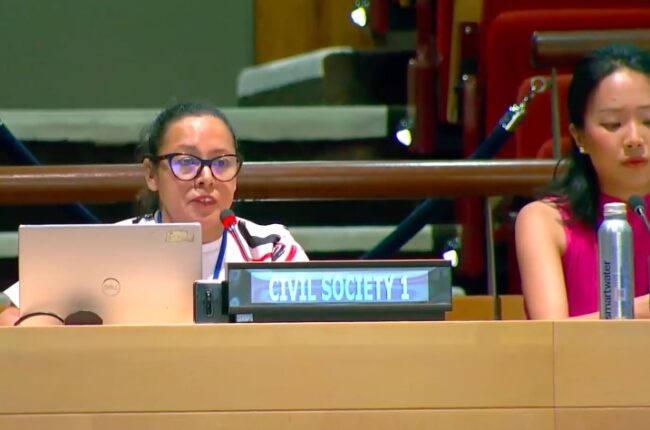
Our representative in New York, Jacqueline Leduc, took part in the 2nd part of the meeting, on Lessons learned and good practices on promoting care and support systems for social development.
She recalled that unpaid family care work IS work – indispensable work that sustains families, communities, society and the economy – benefitting everyone. At MMM we therefore support a multi-stakeholder approach to national care policies, based on the principle of co-responsibility: in addition to governments, communities and private companies also have a key role to play in recognising, redistributing and supporting unpaid care work.
Highlighting the role of grassroots programmes at the community level, she gave the example of the Mothers Centres promoted by our associate member Mothers centres International Network for Empowerment (MINE). Also key are programmes supporting the involvement of fathers in domestic and care work, like those run by our partners MenCare and ACEV.
She also drew attention to the vital role of the private sector in supporting employees with caregiving responsibilities, in particular mothers, and shouldering its share of the costs involved.
In particular, employers should view motherhood and other caregiving responsibilities as a learning experience that equips those unpaid caregivers with soft skills that include among others: planning and organisation, problem solving, active listening and empathy, crisis or conflict management, negotiating, leadership and decision-making skills… all skills that are very much in demand in the corporate world. Recognising and valuing these skills as part of a broader company’s policy to support employees with caregiving responsibilities, is a practical way of valuing their experience as unpaid caregivers.
She concluded by calling on a new social contract where care is everyone’s responsibility.

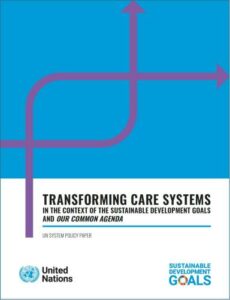 The ECOSOC meeting on Care and Support Systems, which took place on 19 July, also marked the launch of the first UN System policy brief on Transforming care systems. Co-authored by several UN agencies, including UN Women, the International Labour organisation (ILO), and the Office of the High Commissioner for Human Rights (OHCHR), this excellent policy brief brings together all the work done by the UN to advance the issue of care. It provides a framework to develop care policies at every level, including definitions, guiding principles, approaches and policy options that can be contextualised to different socioeconomic realities, and can therefore serve as a useful reference.
At MMM we are delighted that the topic of care is now firmly on the UN Agenda. Through our advocacy, we will continue to push for national care policies that recognise and support mothers in their multiple roles, and advance their rights and those of their children.
 Share
Share Share
Share Print
Print Email
Email
Europe Must Listen to Mothers: Our landmark report heads to the European Parliament
28.08.25
On 22 September 2025, the voices of mothers will take centre stage in Brussels. For the first time, Make Mothers Matter (MMM) will present its State of Motherhood in Europe
Belgian Mothers Face Alarming Rates of Burnout and Perinatal Depression, New EU Survey Finds
03.07.25
Belgian mothers are facing a mental health crisis. According to the State of Motherhood in Europe 2024 survey by Make Mothers Matter (MMM) and Kantar, Belgium reports the highest rates
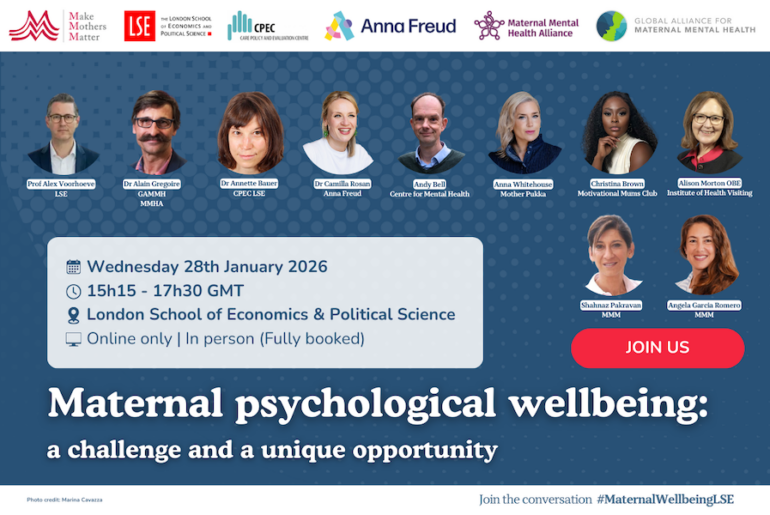
Maternal Psychological Wellbeing: A Challenge and a Unique Opportunity
13.01.26
Wednesday 28 January 2026 | 15:15 – 17:30 GMT London School of Economics & Political Science (LSE) – Live broadcast #MaternalWellbeingLSE Maternal mental health is one of the most pressing