Recognising Mothers, Reducing Poverty
A call for an inclusive EU Anti-Poverty Strategy
23.10.25

Make Mothers Matter welcomes the opportunity to contribute to the European Commission’s first comprehensive Anti-Poverty Strategy and calls for bold, inclusive action to ensure it benefits those who need it most — especially mothers.
Our contribution highlights the structural inequalities faced by mothers across the European Union, examining the barriers that prevent them from fully participating in social and economic life. It also provides concrete recommendations to strengthen support systems in health, education, and social protection.
Despite progress in gender equality, mothers across Europe continue to face systemic disadvantages rooted in the unequal distribution of unpaid care work and persistent labour market discrimination. Parenthood often limits women’s opportunities for full employment, career advancement, and economic independence – with long-term consequences for income security and pensions.
Across Europe, millions of women and families experience poverty and social exclusion, with single mothers, caregivers, and other vulnerable women among the most affected. These economic pressures reverberate through families and communities, deepening cycles of disadvantage.
An effective EU Anti-Poverty Strategy must be rights-based and intersectional, addressing the multiple dimensions of poverty and the specific challenges mothers face. It should also recognise the social and economic value of unpaid care work and the wide-range of skills mothers develop – from time management and leadership to empathy and resilience – which strengthen both society and the economy.
Most importantly, the strategy must prevent and reduce poverty at every stage of life, ensuring that no mother or child is left behind and that mothers’ essential contributions are properly recognised and valued.
 Recognising Parenthood Skills
Through caregiving, mothers acquire a wealth of soft skills — including empathy, multitasking, time management, leadership, and conflict resolution — all of which enhance employability, personal growth and social inclusion.
Make Mothers Matter calls for these competencies to be recognised and validated through innovative tools such as those developed in the EU-funded projects MAAM, MAV, and MothersCan, which contribute to make these often invisible skills visible and valued in the workplace.
When properly recognised and supported, parenthood skills benefit not only mothers themselves, but also employers and society as a whole — promoting a more inclusive, resilient, and equitable economy.
Addressing Gender Inequality and Supporting Families
Persistent gender gaps in employment, earnings, and pensions cannot be closed without addressing the unequal distribution of unpaid care work, which falls primarily on mothers. Real gender equality requires that care work be recognised, reduced and redistributed more fairly between men and women and across society.
MMM calls for:
- Active labour market support for mothers re-entering employment or starting businesses.
- Adequate social protection for single mothers and caregivers
- Fair pensions and care credits to prevent old-age poverty among women
- Improved maternal health services, addressing both physical and mental wellbeing during the perinatal period
- Supportive incentives for unpaid care work such community-based and intergenerational childcare, ‘one-stop shops’, and flexible parental leave
- A life-cycle approach to employment, with access to lifelong learning, upskilling and re-skilling opportunities.
The Way Forward
Families are the cornerstone of nurturing care for children and the foundation of social cohesion.  Addressing mothers’ poverty and ensuring they are supported — economically, socially, and emotionally — is essential to achieving the EU’s gender equality goals and the broader Sustainable Development Goals.
Valuing care work and the skills it generates is not only a question of social justice, but also a strategic investment in Europe’s social and economic resilience. Supporting mothers strengthens families, communities and ultimately, Europe as a whole.
👉 Access our policy paper here
👉 Access our policy brief here
 Share
Share Share
Share Print
Print Email
Email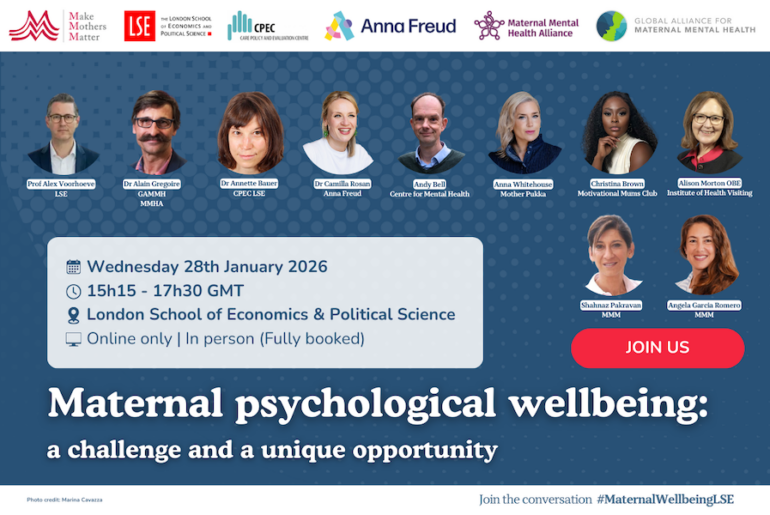
Maternal Psychological Wellbeing: A Challenge and a Unique Opportunity
13.01.26
Wednesday 28 January 2026 | 15:15 – 17:30 GMT London School of Economics & Political Science (LSE) – Live broadcast #MaternalWellbeingLSE Maternal mental health is one of the most pressing

Climate Change: A Maternal Physical and Mental Health Emergency
13.11.25
In the lead-up to the UN climate change conference in Belem, Brazil (COP30), MMM was delighted to collaborate with Dr. Saravanan Thangarajan, a Visiting Scientist & Faculty member at Harvard
Democracy on Hold: The Hidden Penalty for Parliamentarians Who Become Mothers
27.11.25
The European Parliament adopted a legislative resolution on the amendment of the European Electoral act, allowing Members to vote in plenary by proxy voting during pregnancy and after giving birth.