Rethinking Cities Through Care: People, Planet and the 2030 Agenda
20.06.26
UN New York/HLPF – Register now to join us for our 2026 High Level Political Forum side-event online.
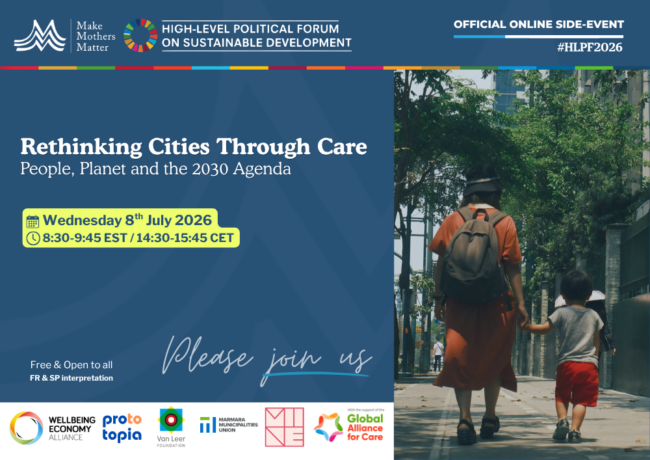
📆 Wednesday 8 July
⏰ 8:30-9:45 am New York (EST) / 14:30-15:45 Paris (CET)
📍 Online – REGISTER HERE
List of speakers:
- Simon Ticehurst, Movements and Advocacy Lead, Wellbeing Economy Alliance (Moderator)
- Celine Charveriat, Founder and Director, Pro(to)topia / Forum for caring societies
- Ayşe Göç Yalçınkaya, Expert of International Affairs and Projects, Marmara Municipalities Union (Türkiye)
- Gemma Parera Álvarez, Technical advisor, Social Sustainability, Life Cycle and Community Area, Barcelona Provincial Council
- Victoria Chavez Barriga, Senior Urban95 Expert, Bernard van Leer Foundation
- Rachel Castleberg, Project Coordinator, Mother centres International Network for Empowerment (MINE)
- Saravanan Thangarajan, Founder, CliMent; Public Health Systems & Global Health Delivery Consultant; Mittal Associate, Harvard University
- Ana Moreno, Technical Secretary, Global Alliance for Care (Closing remarks)
- Shahnaz Pakravan, Communication Manager, Make Mothers Matter (Welcome & introduction)

Why promote Caring cities?
The unequal distribution of unpaid care work lies at the heart of gender inequality and remains a major driver of economic and social injustice for women, particularly mothers. Recognised under SDG 5, Target 5.4 of the 2030 Agenda for Sustainable Development, the international community has committed to:: “Recognise and value unpaid care and domestic work through the provision of public services, infrastructure, and social protection policies, and promote shared responsibility within the household and family, as appropriate in each country.”
While national policies are essential to advancing this agenda, local governments play a critical role in delivering the public infrastructure and services that support parents and other unpaid caregivers. These include basic services such as water and sanitation, energy, transportation and Internet access, as well as social protection, healthcare, housing, care services, parental support and education. Ensuring that these services are sustainable and inclusive also contributes to the achievement of multiple Sustainable Development Goals, including SDG 6 (Clean Water) and sanitation, SDG 7 (Affordable and clean Energy), SDG9 (Industry, Innovation and Infrastructure), and SDG 11 (Sustainable Cities and Communities)—all of which are under review this year.
In this context, the concept of “Caring Cities” has emerged as a vision for reshaping urban environments through people-centred planning and policymaking, It calls on local governments to prioritise human well-being, equity, environmental sustainability and quality of life alongside economic development. This approach recognises care work – including childcare and care for older and persons with disabilities – as fundamental to the functioning of families, communities, societies and economies.
By investing in care-centred public infrastructure and services, cities can better support unpaid caregivers, beginning with mothers, while promoting a more equitable distribution of care responsibilities and costs between women and men, and among families, governments, and the private sector.
Objectives of the Side-Event
The aim of this side event, which will take the form of a panel discussion, is to highlight the transformative potential of caring cities in terms of recognising, supporting and redistributing unpaid care work, promoting women’s rights – particularly those of mothers – and working across sectors to implement the 2030 Agenda.
Our objectives:
- Explore how caring cities can address the issue of the inequitable distribution of unpaid care and domestic work in a cross-sectoral manner that can also foster synergies between SDGs
- Provide concrete examples of cities or programs that have been implementing the vision of caring cities through cross-sectoral care systems that empower both caregivers and care recipients
- Highlight key components and policies of caring cities
- Call for governments at every level to promote caring cities as part of accelerating the implementation of the 2030 agenda
→ REGISTER HERE
 Share
Share Share
Share Print
Print Email
Email
Maternal Psychological Wellbeing: A Challenge and a Unique Opportunity
13.01.26
Wednesday 28 January 2026 | 15:15 – 17:30 GMT London School of Economics & Political Science (LSE) – Live broadcast #MaternalWellbeingLSE Maternal mental health is one of the most pressing

Climate Change: A Maternal Physical and Mental Health Emergency
13.11.25
In the lead-up to the UN climate change conference in Belem, Brazil (COP30), MMM was delighted to collaborate with Dr. Saravanan Thangarajan, a Visiting Scientist & Faculty member at Harvard

Democracy on Hold: The Hidden Penalty for Parliamentarians Who Become Mothers
27.11.25
The European Parliament adopted a legislative resolution on the amendment of the European Electoral act, allowing Members to vote in plenary by proxy voting during pregnancy and after giving birth.