Care central to the realisation of Economic, Social and Cultural Rights
21.09.23
UN Geneva, Human Rights Council - As OHCHR seeks to reinforce its work on Economic, Social and Cultural Rights, MMM highlights the centrality of Care to the realisation of these rights, in particular the unpaid care work of mothers. We also call for the recognition, support and fairer distribution of this work.
The following is the full text of the statement we delivered at the UN during the discussion on the Office of the High Commissioner for Human Rights’ vision to reinforce its work on Economic, Social and Cultural Rights. This discussion took place on 15th September 2023 as part of the 54th session of the UN Human Rights Council.
Make Mothers Matter welcomes OHCHR’s vision to reinforce its work on Economic, Social and Cultural Rights. We agree that urgent action is needed to deliver these rights in line with the 2030 Agenda.
We regret however that the importance of care and the strengthening of care and support systems as a means to respect and advance the enjoyment of human rights for all, is absent from this vision.
To quote Sec General Guterres, ‘The pandemic has shown us who is doing the work that really matters: nurses, teachers, care workers. As we recover, we need to remember this. It is time to end the inequities of unpaid care work and create new economic models that work for everyone.’
Strengthening care and support systems should be at the heart of such new models, which must be based on Human Rights and serve the wellbeing of both people and the planet.
This means recognizing the essential value of the unpaid and underpaid work of caring, whose inequitable distribution has been a driver of exclusion and discrimination for women and girls, in particular for mothers.
It also means supporting and redistributing this vital work more equitably, not only between men and women, but also across society.
Care connects to many if not all human rights, in particular economic, social and cultural rights. It concerns all of us. It is time to put care at the centre, and to frame care as a right: right to care and right to be cared for.

 Share
Share Share
Share Print
Print Email
Email
Europe Must Listen to Mothers: Our landmark report heads to the European Parliament
28.08.25
On 22 September 2025, the voices of mothers will take centre stage in Brussels. For the first time, Make Mothers Matter (MMM) will present its State of Motherhood in Europe
Belgian Mothers Face Alarming Rates of Burnout and Perinatal Depression, New EU Survey Finds
03.07.25
Belgian mothers are facing a mental health crisis. According to the State of Motherhood in Europe 2024 survey by Make Mothers Matter (MMM) and Kantar, Belgium reports the highest rates
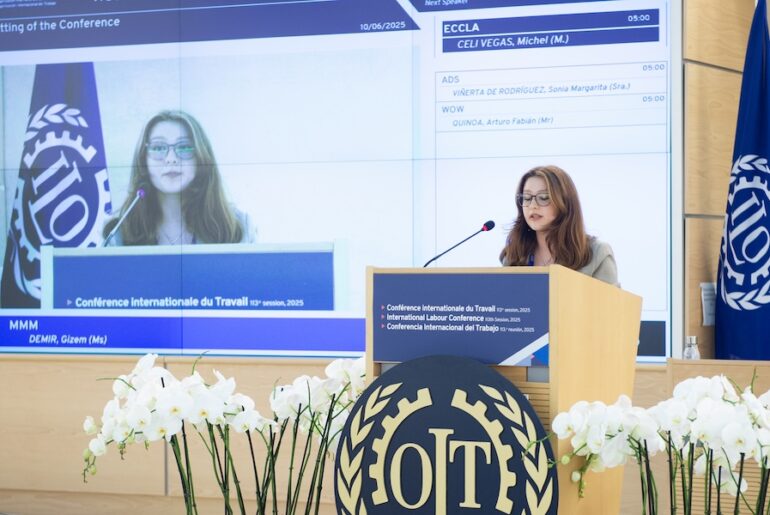
Recognising Unpaid Care Work and addressing Its Unequal Distribution: A Key Step in Tackling Informal Employment
15.06.25
UN Geneva – At the 113th International Labour Conference (ILC), Make Mothers Matter (MMM) brought the perspectives of mothers and other unpaid caregivers to two key agenda topics: the transition