Eradicating Poverty Beyond Growth: MMM’s Take on the New UN Roadmap
04.05.26
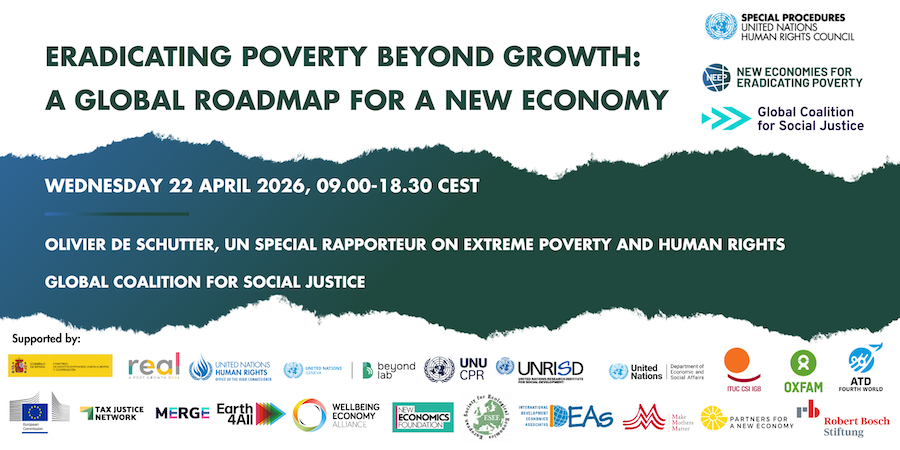
UN Geneva – In April, MMM was invited to attend the high-level launch of the UN Special Rapporteur Olivier de Schutter’s “Roadmap for Eradicating Poverty Beyond Growth”.
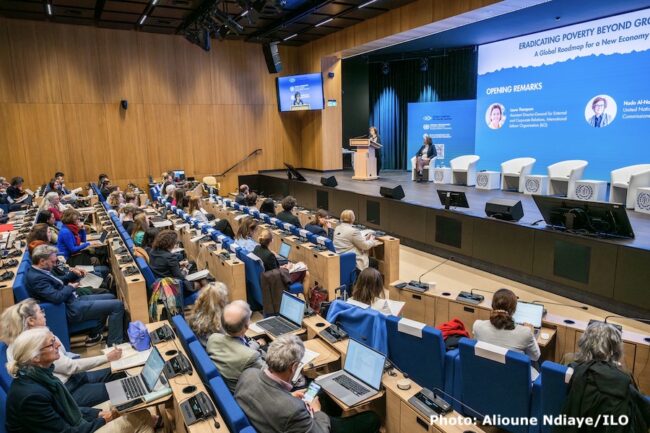
Presented at the International Labour Organisation (ILO) headquarters in Geneva, the Roadmap, which is Olivier de Schutter’s final report as a Special Rapporteur on extreme poverty and human rights, challenges decades-old assumptions that economic growth is the primary solution to poverty: it argues that the current growth-centric model has failed to deliver inclusive prosperity, instead, concentrating wealth among elites, undermining democracy, exploiting natural resource and labour–including women’s unpaid care work – and accelerating ecological collapse. According to the Special Rapporteur, pursuing GDP growth often worsens inequality, weakens labour protections, and distorts policy priorities away from human well-being.
The contents of the Roadmap
Developed with input from over 400 experts and organisations worldwide, including MMM, the Roadmap proposes a transition to a “human rights economy”, an economic approach that places human rights, people, and the planet at the centre of economic decision-making, rather than prioritising corporate profit or GDP growth. It is an approach similar to the concept of a ”wellbeing economy”, which MMM has been promoting for many years as a member of the Wellbeing Economy Alliance, where human rights obligations are used to guide policymaking. Such a new economic system seeks to better value what matters, including care.
The Roadmap is structured around five key pillars:
- transforming economic systems
- rethinking labour markets and valuing care work
- ensuring universal social protection and essential services
- managing climate and resources sustainably
- reforming global trade, finance, and debt structures
A sixth, transversal pillar emphasizes democratic planning and participatory governance to ensure legitimacy and accountability.
It stresses that poverty is not accidental but produced and reproduced through choices which are made on how to organise production, distribute resources, value care, and structure power. Poverty eradication therefore requires structural transformation, not just redistributive tweaks after growth occurs.
While acknowledging that low-income countries may still need some growth to build infrastructure and services, the roadmap insists that this growth must be inclusive, sustainable, and oriented toward local needs rather than export-driven; it is a decolonial project. High-income countries, having contributed most to ecological damage and inequality, bear greater responsibility to reduce consumption, cancel unsustainable debts, and support poorer countries.
Last but not least, the Roadmap also calls for new metrics beyond GDP to measure well-being, inequality, and ecological health–a call that resonate with the work the UN High-Level Expert Group on beyond GDP, established by the UN Secretary General to provide a conceptual framework for such metrics, whose final report is due in May.
Our take
MMM welcomes the Roadmap’s important focus on care, which is framed as foundational economic infrastructure, and makes it very relevant for mothers: “Care work and social reproduction are foundational to both economic life and poverty eradication. States must strengthen a fair social organisation of care by recognising, reducing and redistributing unpaid care work, by rewarding those (mostly women) who perform it and by ensuring adequate representation of care workers; ensuring decent working conditions, fair remuneration and social protection for paid care workers; and investing in universal, high-quality and accessible care systems. Reorienting economic priorities toward care, social cohesion and collective well-being strengthens resilience, reduces gender and social inequalities, and addresses the structural drivers of poverty.”
We also welcome the focus on prevention: the Roadmap makes it clear that eradicating intergenerational poverty requires investing in early childhood development, health, education, care, and social protection–a recommendation which is totally aligned with our priorities.
The report presents a toolbox of policy proposals, many of which build on MMM recommendations. Notably, these include:
- investments in care infrastructure and services or care-system, “to rebuild care as a public good and human right”, and recognising that care should be a collective responsibility
- universal social protection, so that mothers and other unpaid caregivers, as well as informal workers can benefit from a minimum of social protection, which is usually tied to formal employment
- a universal care income, to “rewards active contributions to social and ecological reproduction”, and minimum income guarantee to ensure that unpaid caregivers and their care receivers live decently
- universal basic public services to answer basic needs, including water & sanitation, healthcare, care, education, energy, transport, Internet access and communication
- the reduction of working time so that everyone has more time to care, including to selfcare
- a universal child allowance to recognise that childcare responsibilities should be shared collectively, and that every child is entitled to a fair start in life
“Universal basic services and robust social protection thus are not burdens on an otherwise productive economy, they form the basis of the economy — the collective infrastructure through which societies reproduce themselves, care for their members, and generate the conditions under which people can genuinely flourish.” Par. 212, Preliminary version of the Roadmap
Way forward
For Olivier de Schutter, moving “beyond growth” is not anti-development but a necessary condition for achieving genuine, sustainable human rights fulfilment. He urges the international community to embed these principles in future global development goals post-2030, warning that without rethinking foundational economic assumptions, poverty eradication will remain elusive. The human rights economy offers a legally grounded, universally applicable framework to make this shift possible.
The Roadmap will be presented at the June session of the UN Human Rights Council, but work will not stop there: Olivier will continue to work to advance the Roadmap and monitor its implementation through his new initiative, New Economies for Eradicating Poverty Beyond Growth (NEEP).
At MMM we are proud to be part of this important journey and will continue to support Olivier and his team in this new initiative.
A preliminary version of the Roadmap is available on the NEEP website.
→ See also MMM’s initial contribution to the Roadmap
 Share
Share Share
Share Print
Print Email
Email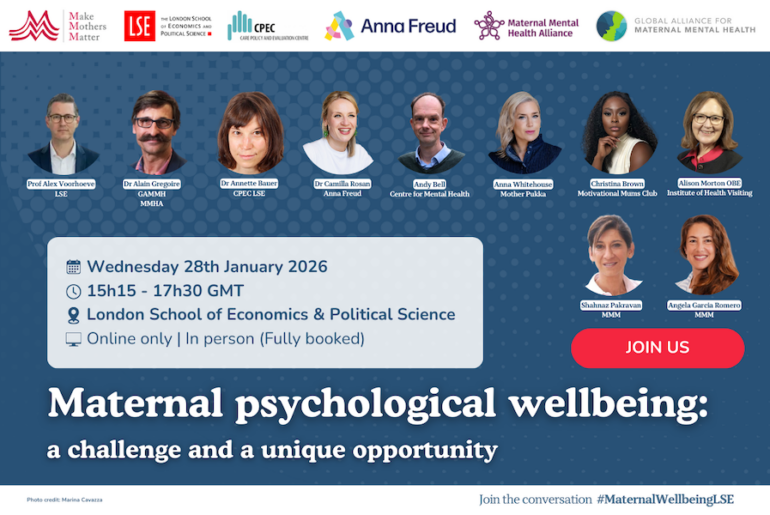
Maternal Psychological Wellbeing: A Challenge and a Unique Opportunity
13.01.26
Wednesday 28 January 2026 | 15:15 – 17:30 GMT London School of Economics & Political Science (LSE) – Live broadcast #MaternalWellbeingLSE Maternal mental health is one of the most pressing

Climate Change: A Maternal Physical and Mental Health Emergency
13.11.25
In the lead-up to the UN climate change conference in Belem, Brazil (COP30), MMM was delighted to collaborate with Dr. Saravanan Thangarajan, a Visiting Scientist & Faculty member at Harvard
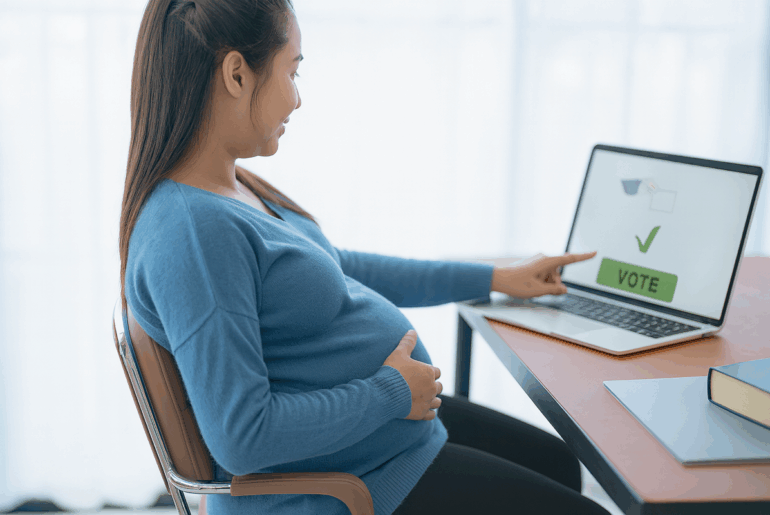
Democracy on Hold: The Hidden Penalty for Parliamentarians Who Become Mothers
27.11.25
The European Parliament adopted a legislative resolution on the amendment of the European Electoral act, allowing Members to vote in plenary by proxy voting during pregnancy and after giving birth.